
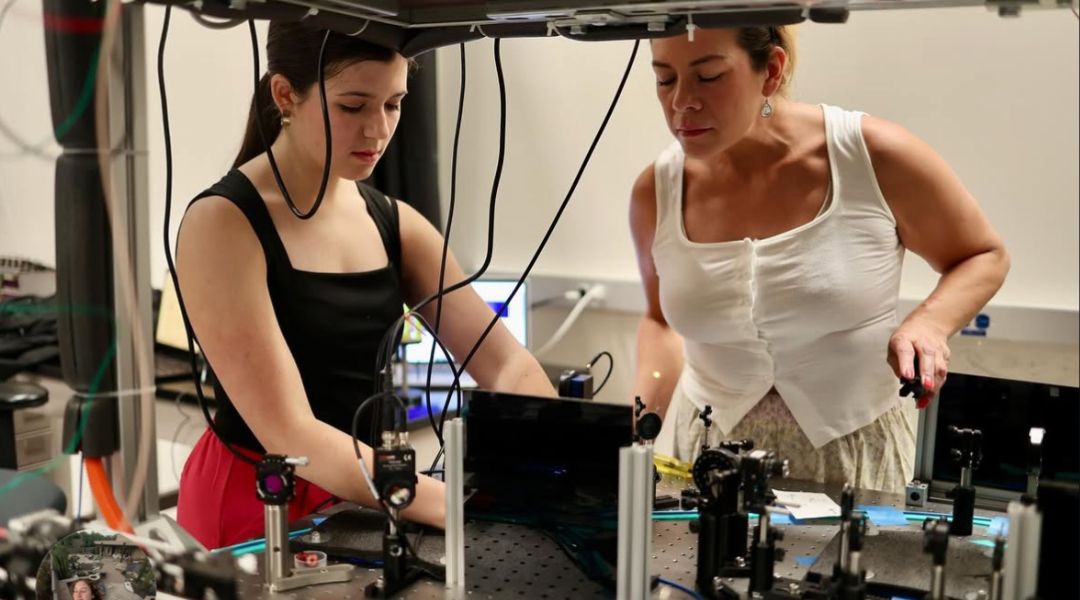
For Aubrey McNiel, the word that best describes her is “and.”
She is a physicist and an engineer. A researcher and a musician. Someone who studies quantum mechanics and performs classical music.
“I think something that’s really great about applied physics is that everyone seems to have some sort of an ‘and’ going on,” McNiel said.
This fall, McNiel will bring her many interests to Rice University as an applied physics doctoral student. Originally from Bixby, Oklahoma, she recently graduated from the University of Oklahoma with two bachelor’s degrees, one in engineering physics and another in vocal performance.
Her path to physics was not a straight one. McNiel began college studying biomedical engineering, but an encounter with the engineering physics department encouraged her to take a closer look at the field. She soon found herself drawn to classical mechanics and, especially, quantum mechanics.
“From the moment I started my quantum mechanics class, I started doing research in an atomic physics lab a couple floors down in the same building,” McNiel said. “And then I realized that this was kind of what I’d meant all along when I said that I wanted to be an engineer.”
The laboratory allowed her to combine several disciplines. She designed experimental components using AutoCAD, worked with electronics and water systems and gained experience in optical engineering. During her undergraduate career, she explored research in atomic physics, quantum devices, and nanophotonics before developing an interest in theoretical work.
“I really appreciated that it was really challenging and that it was really diverse in the sort of things you got to do on a day-to-day basis,” she said.
At Rice, McNiel hopes to focus on quantum simulation, an area of research that uses carefully controlled quantum systems to investigate complex problems that can be difficult to model with conventional computers. She is particularly interested in the intersection of atomic physics and condensed matter physics.
“Something I’ve gotten super excited about for the near future is quantum simulation, which is something that Rice has a big hotspot for, and so that was one of the main reasons I chose Rice,” she said.
Rice’s interdisciplinary approach to applied physics also stood out during her visit for admitted students. McNiel met faculty and graduate students whose research crossed traditional academic boundaries, including students working with advisors in both theoretical and experimental physics.
“Visiting for the admitted students day was something that really helped set my mind to coming to Rice,” she said. “I appreciate that applied physics spirit in general is to explore all of those intersections and all of the unique frontiers that those create.”
McNiel also found that the Rice community was interested in the other important part of her life: music.
She began studying music theory in high school and continued developing as a vocalist at the University of Oklahoma. In addition to performing classical music, she has experience in songwriting and recording.
When McNiel spoke with Rice professors, she expected to explain that music would need to take a back seat during her doctoral studies. Their response surprised her.
“This was the first university that one of the first questions whenever I actually got to talk with all of the professors individually was, ‘Oh yes, and like tell me more about this music side of your life that you’ve had going on all along,’” she said. “Everyone was genuinely interested to hear about it.”
McNiel hopes to explore opportunities to sing at Rice, including the graduate student choir and university chorale. She is also looking forward to experiencing Houston’s music scene, from the Houston Symphony to live jazz performances by local artists.
“It feels like there are so many different opportunities for anything you want to explore right there at your fingertips,” she said.
As she prepares for Rice, McNiel is eager to begin laboratory rotations, meet her new classmates, and continue developing as a researcher. She sees the doctoral experience as an opportunity to devote herself to learning and contributing new knowledge to her field.
“I’ve been looking forward to graduate school as a long kind of six-year season of becoming, both becoming the scientist that I really want to be and becoming knowledgeable and rigorous enough in the field that I’m doing to continue to really make strides in it,” she said.
At Rice, McNiel will not have to choose between the different parts of her identity. Her next chapter will be defined, fittingly, by “and.”