
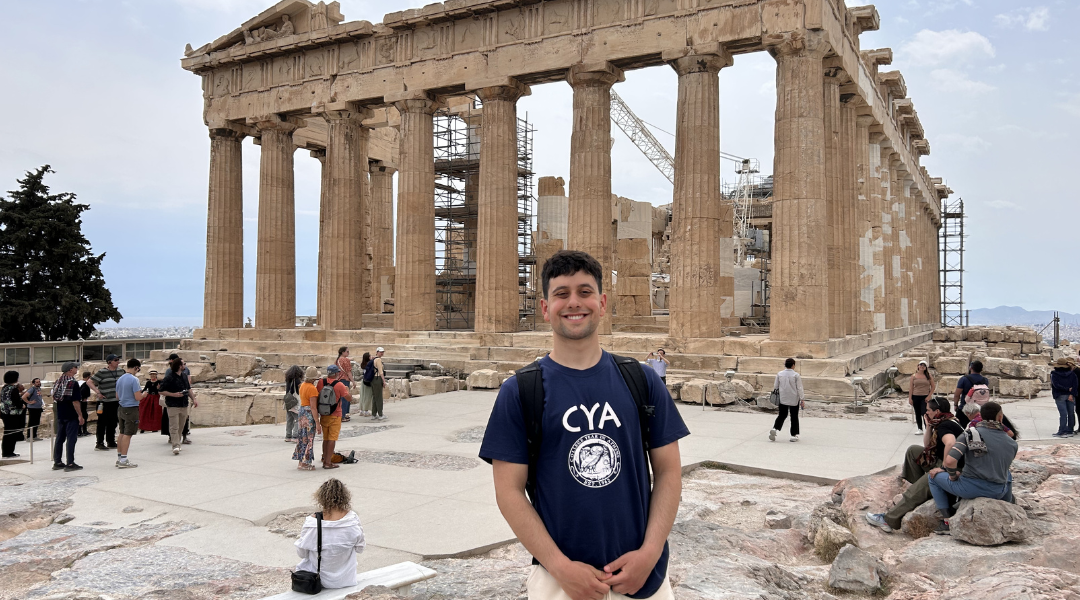
For Deniz Eksioglu, Rice University offered the best of both worlds: a close-knit campus community and the opportunities of one of the nation’s largest cities just beyond the hedges.
Coming from Purdue University, where major cities were hours away, Eksioglu said Rice’s location in Houston stood out. He was drawn to the idea of studying and conducting research in a campus environment while also having access to the possibilities of a major metropolitan area.
“What I really liked about Rice was that there was the campus and then there was a city, so I can choose from both,” Eksioglu said. “I like the fact that I get to live and work somewhere that’s more like a campus town-ish area, and if I want to go to the city, it’s right there.”
That combination helped make Rice a natural next step for Eksioglu, an incoming graduate student in materials science and nanoengineering and a recipient of the National Science Foundation Graduate Research Fellowship Program.
A native of Fayetteville, Arkansas, Eksioglu earned his undergraduate degree in biomedical engineering from Purdue, where he discovered a passion for research and began seeing a future for himself in a doctoral program.
“Ever since my sophomore year, I knew I wanted to do a Ph.D.,” Eksioglu said. “That’s when I really started doing research.”
That research experience eventually led him to neural engineering, an interdisciplinary field focused on understanding and interfacing with the nervous system. During his undergraduate studies, Eksioglu worked on minimally invasive neural interfaces, devices designed to record from or stimulate neural activity in the brain, spinal cord or peripheral nerves.
For Eksioglu, the materials behind those devices became especially important. His research explored hydrogels and other flexible materials that better mimic the body and the brain's mechanics, with the goal of making implanted devices more effective and less likely to trigger an immune response.
“When you’re implanting a metal chip in there, the body wants to go attack it because it realizes that’s not supposed to be there,” Eksioglu said. “But if you cover it in polymers or give it the materials that mimic the brain, it’s basically like an invisible cloak.”
That interest in the intersection of materials science and neural engineering helped lead Eksioglu to Rice, where he will begin graduate studies in materials science and nanoengineering. He said Rice’s strength in neuroengineering research sets the university apart.
“That’s why I came to Rice,” Eksioglu said. “There’s so much neuroengineering research going on, great professors doing impactful stuff.”
His connection to Rice began before admission. Eksioglu first visited campus through the Gulf Coast Undergraduate Research Conference, GCURS, an experience he said helped him meet faculty, learn more about the university and imagine himself as a graduate student in Houston.
“I got to meet a lot of people during the conference, and I think that really boosted my chances of coming to Rice,” he said. “That was really exciting.”
Eksioglu will arrive at Rice with additional national recognition as a 2025 Goldwater Scholar. After a demanding application season that included graduate programs and competitive fellowships, he said Rice’s early acceptance gave him a needed boost.
“Rice came out with an early acceptance letter for me, really boosted my confidence, made me feel great,” he said.
The NSF news came later, and unexpectedly, on a Sunday.
“I just checked my phone, and I got an email,” Eksioglu said. “I saw you received it. I was in shock. I was super happy.”
Now, with Rice and the NSF fellowship supporting his next step, Eksioglu said he feels ready for the challenge ahead.
“I’m super excited to be at Rice,” he said.