
For Olivia Cunningham, the path to digital health began on the field.
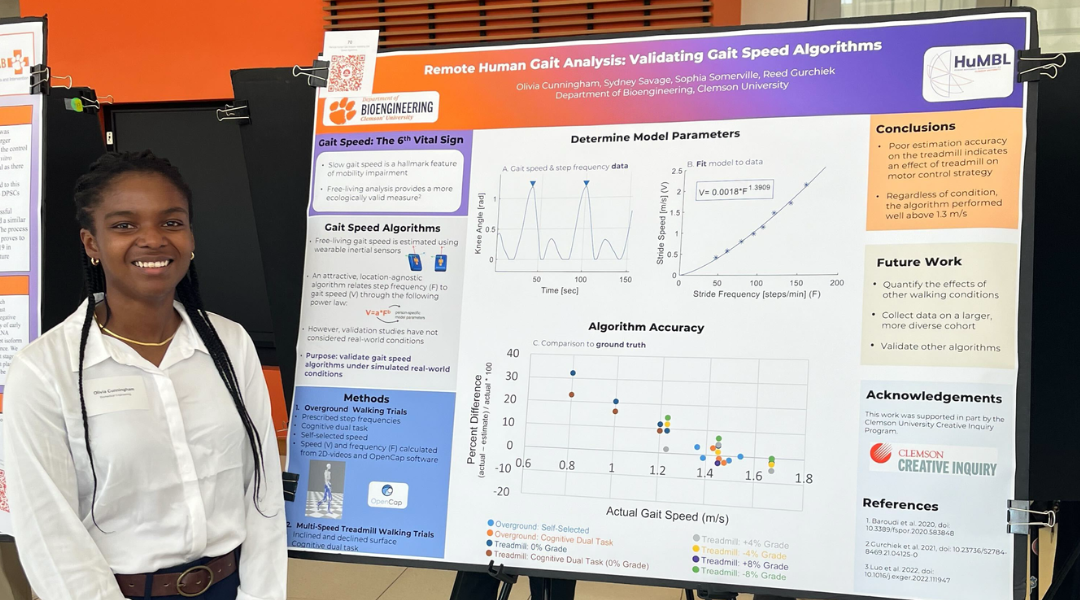
A lifelong athlete who grew up playing soccer before joining the Clemson University women’s rugby team, Cunningham has long understood the importance of movement. At Clemson, where she studied biomedical engineering, that interest became part of her academic life through biomechanics research, sensor validation and remote gait analysis.
Now, as an incoming student in Rice University’s new Master of Digital Health program, Cunningham is bringing those interests to Houston, where she hopes to help shape the future of health care through technology.
“I got into biomechanics research because I love sports and I love movement, and so I want to continue that in my academic life,” Cunningham said. “During my research in biomechanics I worked on remote gait analysis, and so I learned a lot about remote monitoring, healthcare monitoring, and how important that can be.”
Her work in biomechanics helped her see how engineering, movement and health care could intersect in meaningful ways.
Rice’s Master of Digital Health, housed in the Department of Electrical and Computer Engineering, is an interdisciplinary graduate degree designed to train “engineer-leaders” to invent the future of health care. The program blends engineering fundamentals, entrepreneurial problem-solving, artificial intelligence and digital technologies for health care, preparing students to innovate across hospitals, health insurers and medical technology companies.
For Cunningham, the program felt like a natural fit.
“When I learned about the digital health program, I thought that it was the perfect kind of combination of all of those things,” she said.
The program is led by the Rice Digital Health Initiative, a multi-department effort focused on shaping foundations and accelerating translation into products. In 2024, the initiative launched the Houston Methodist-Rice Digital Health Institute, bringing engineering and clinical leadership together to accelerate research and entrepreneurship.
That proximity to clinical expertise was one of the biggest factors in Cunningham’s decision to come to Rice.
“Definitely being right next to the medical center was huge for me, and the program actually does a yearlong capstone in collaboration with the medical center, so that was also really huge for me in deciding to come here,” Cunningham said. “Definitely getting the chance to work with clinicians was a big part of it.”
The move to Rice will also mark a major personal transition. Cunningham, from Anderson, South Carolina, said Clemson was about 30 minutes from home. Houston is a much bigger step.
“This will be by far the furthest I’ve been away from home,” Cunningham said. “I moved 30 minutes down the road to go to Clemson, so this will be huge.”
She said visiting Rice helped her picture the next chapter.
“I loved the city,” Cunningham said. “I love walking around and seeing all the different people that were there. It really is an amazing city. I’m excited to be there.”
She was also drawn to the culture she found on campus.
“When I visited Rice and was able to talk to students and people on campus, just seeing how much everyone seems to care about what they’re doing and about improving the world and the community, I think that was huge,” Cunningham said. “I loved seeing that, and it’s something I definitely want to be a part of.”