
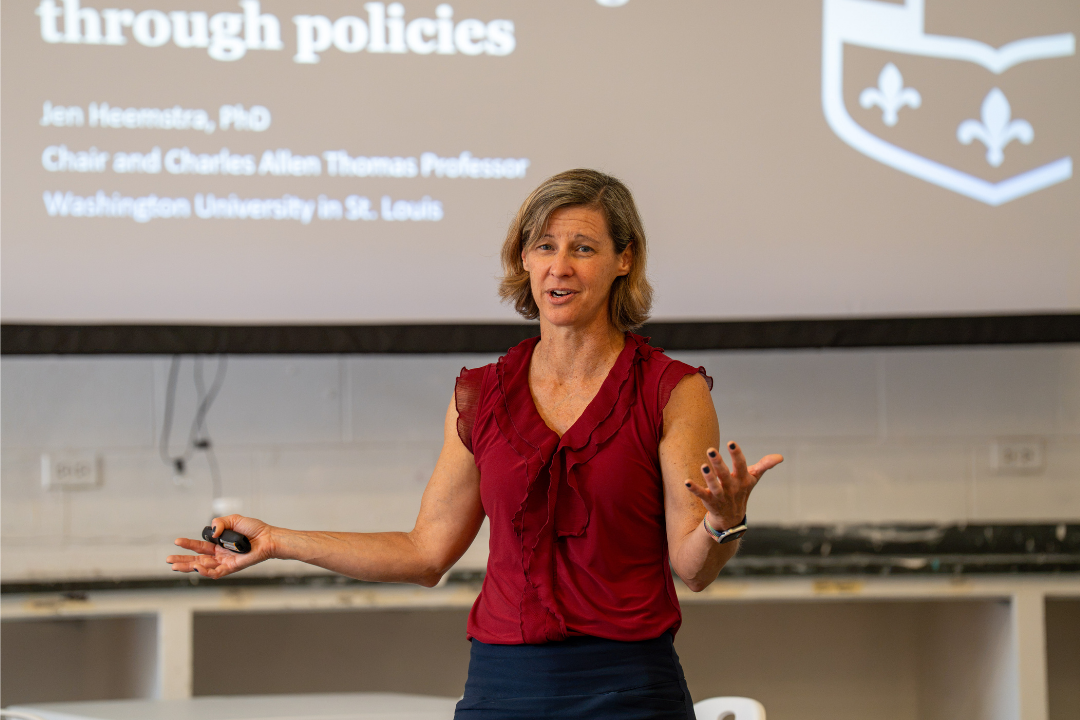
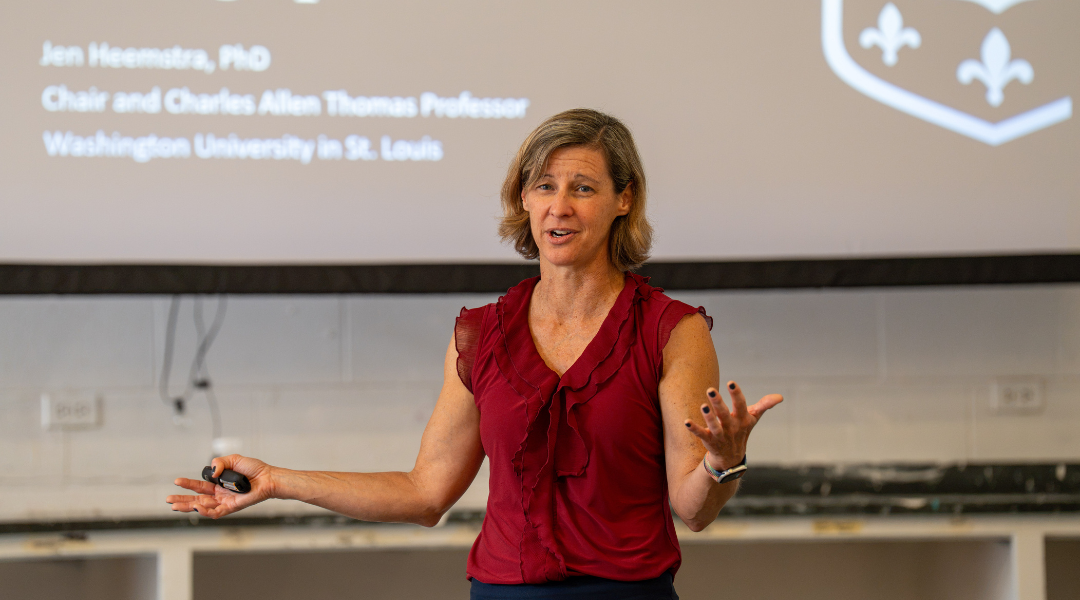
About 15 postdoctoral scholars in the Rice Academy of Fellows gathered for a leadership workshop in the Office of Graduate and Postdoctoral Studies with chemist, author and mentor Jen Heemstra, who challenged the group to think intentionally about the cultures they create in research labs.
Heemstra is the Charles Allen Thomas Professor and chair of the Department of Chemistry at Washington University in St. Louis. Her interdisciplinary research group develops tools for biosensing and bioimaging by harnessing the molecular recognition and self-assembly properties of nucleic acids and proteins. Her work has received support from the National Institutes of Health, National Science Foundation and Department of Defense.
The conversation focused on a part of scientific training that researchers do not always receive: how to lead people. Heemstra recalled encountering a serious conflict in her lab early in her faculty career and realizing that her scientific preparation had not taught her how to manage it.
“Nobody prepared me for this,” Heemstra said. “I literally opened my browser and Google searched conflict resolution.”
That experience helped shape her approach to mentorship and her book, “Labwork to Leadership.” Heemstra also co-founded #MentorFirst, an initiative that encourages academic leaders to place mentorship at the center of their work.
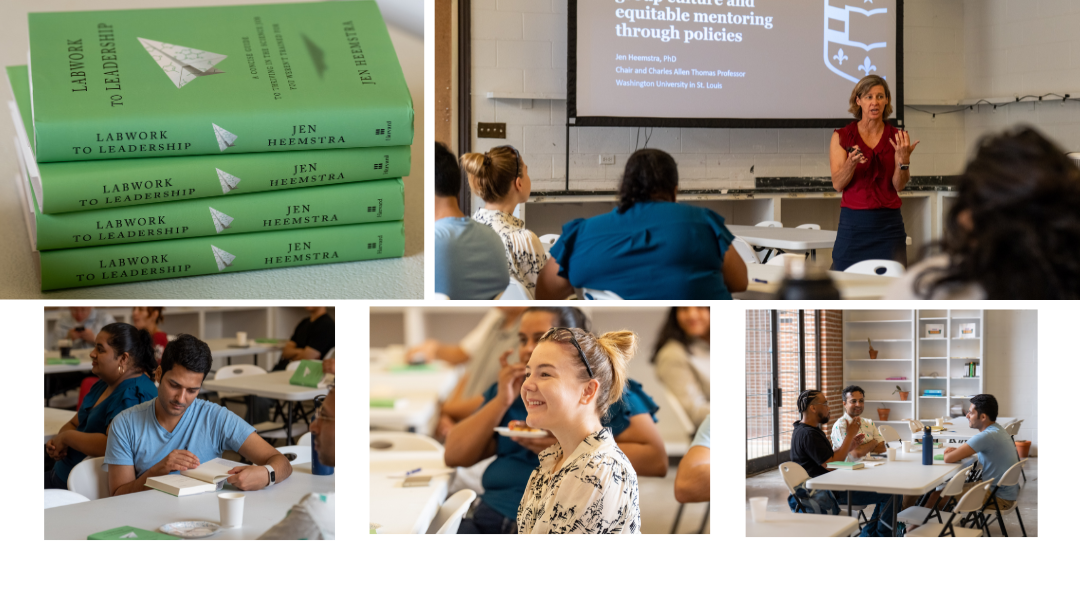
During the session, Heemstra used healthy soil as a metaphor for a productive research environment. Mentors cannot create growth for another person, she said, but they can establish conditions that make growth possible.
“I can’t make you grow any more than I can make a plant grow, but I can create healthy soil,” Heemstra said. “Our part is to create an environment where, when they encounter difficulties, it’s because research is difficult, not because the environment is difficult.”
Heemstra encouraged the fellows to translate their values into practical systems. Those can include written expectations, regular feedback, clear communication practices, professional development opportunities and policies supporting time off, mental health and personal emergencies. She also stressed that policies work best when team members help develop them and revisit them regularly.
The fellows applied those ideas to their own mentoring and future research groups, discussing ways to strengthen collaboration, resolve conflicts and balance professional development with research responsibilities. Heemstra emphasized that leaders should give mentees clear options for addressing disagreements while recognizing when university procedures must guide the response.
The Rice Academy invites select postdoctoral scholars to participate in a vibrant interdisciplinary community. Rice Academy programming focuses on professional development, fostering lively intellectual exchange among fellows and speakers and helping to prepare postdocs for success as they pursue the next steps in their careers.
Heemstra closed by reminding participants that mentorship can have an impact well beyond a single lab or career stage. The environments researchers create influence not only their current mentees, she said, but also how those mentees will lead and mentor others.
“You have the potential to have this generational impact on academic culture,” Heemstra said.