
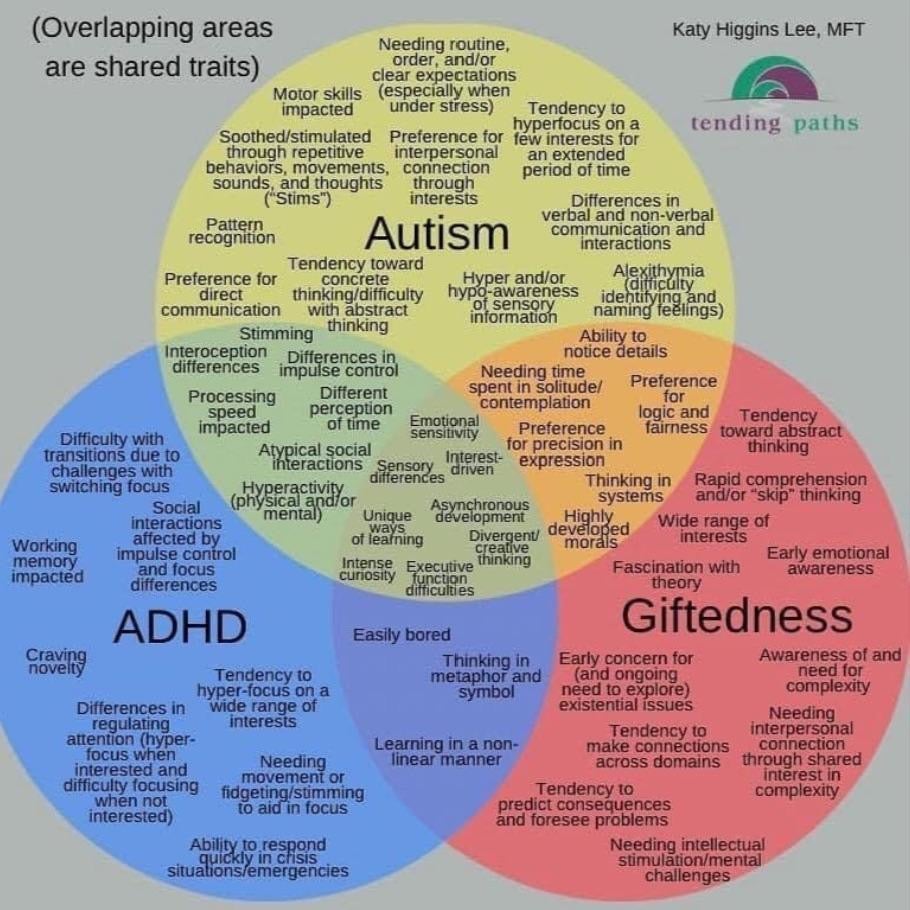
Nature is perfect. It knows exactly how to heal itself and balance things out. When a thing or person lacks an ability, it makes up for that through other outlets, and sometimes these abilities become so heightened that they are considered superpowers. Some of these superpowers that a neurodiverse individual may have include:
- Hyperfocus: Intense concentration on a particular task for an extended period without distraction, thereby achieving high productivity and mastering the craft. This superpower is dominant in persons with ADHD.
- Pattern Recognition: A heightened ability to spot patterns, connections, and trends that others miss. They can be great problem solvers and can easily spot errors and anomalies. These people are good at solving puzzles and maze tasks. You know that friend who is very good with the Rubik’s Cube? Some autistic people have this superpower.
- Creative Thinking: They can possess above-average thinking. They always think outside the box. They are usually very good with verbal and quantitative reasoning. Some people with dyslexia fall under this category.
- Rapid and Efficient Processing: They are generally above-average at completing tasks. They are not just quick; they are accurate, too.
- Empathy: These heroes are very emotional and empathetic because they have lived on the margins. They easily relate to people and are always willing to offer assistance.
- Creativity: Most of them are highly talented creatives with excellent writing, music, acting, painting, and sculpting skills - to name a few. They are just creative geniuses.
- Color Sensitivity: Some actually see ultraviolet/infrared lights! Some colours also come alive to these people more than others. And these could be very useful in solving police cases!
What is most fascinating to me is that the people called “ogbanje” and “awgu” exhibit one or more of these superpowers, which may make people think they are atypical. They are just not aware, like many of us. What is more interesting is that many successful icons have been so open about their struggles with neurodivergence! They have been inspiring and encouraging us by sharing their challenges and stories. Some of them are:
- Bill Gates (ADHD and Dyslexia)
- Emma Watson (ADHD)
- Nicki Minaj (ADHD)
- Billie Eilish (Tourette’s Syndrome)
- Tim Burton (Autism)
Neurodiversity was first coined in the late 1990s by an Australian sociologist, Judy Singer, describing it as the differences that each of our brains represents. Singer opines that it is a social category that should be treated in the same way as race, gender, and socio-economic class. Neurodiversity is, in fact, an amalgamation of “neurological” and “diversity”. It is estimated that 15-20% of the global population is neurodiverse. Did you know that studies have proven that these superheroes are 90% more efficient at their workplaces and academic institutions when given tasks that align with their superpowers than neurotypicals?
As a tree needs living things to take in carbon dioxide, and vice versa, so do neurotypicals need neurodivergent individuals, and vice versa. Where one lacks, the other completes. And learning about neurodivergence promotes inclusiveness, which is a significant step toward achieving unity in diversity.
If you are neurodivergent and it is impeding your academic progress and mental health, please do not hesitate to reach out to the Student Resource Disability Centre and access the resources you need to excel.