
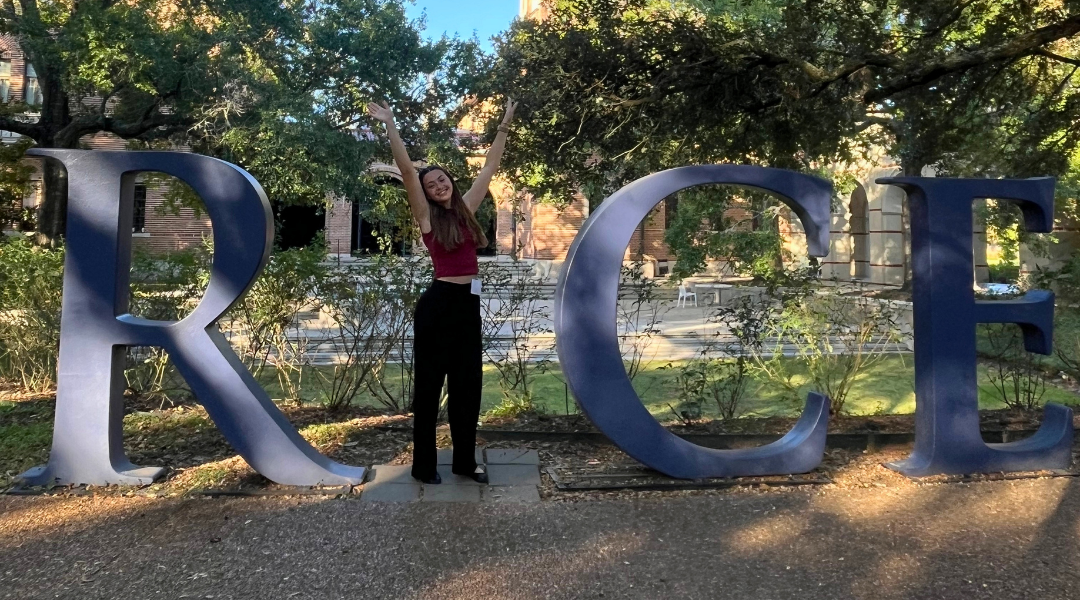
When Olivia Beddow first came to Rice University for the Gulf Coast Undergraduate Research Symposium, she expected a chance to present her research and learn more about graduate school. What she found was something more powerful: a firsthand look at the community she could one day join.
Beddow, an incoming chemistry doctoral student and Goldwater Scholar from Wilmington, Delaware, said GCURS gave her an early and meaningful connection to Rice. The symposium, which brings undergraduate researchers to campus to present their work, meet faculty and engage with graduate students, became an effective introduction to the university’s research culture.
“When I got to GCURS, I did not anticipate the entire symposium to be facilitated by graduate students,” Beddow said. “They were just so helpful and welcoming the entire weekend.”
Just as important, Beddow said, was seeing Rice faculty actively involved in the symposium. For a prospective graduate student, that level of engagement mattered. It showed her that faculty were not only invested in the research being presented, but also in the undergraduate students considering what their next academic step could be.
That combination of graduate student leadership and faculty presence helped Beddow picture herself at Rice, where she will pursue a Ph.D. in chemistry. A graduate of St. Joseph’s University, Beddow majored in chemistry and minored in philosophy, an academic pairing that reflects both her scientific curiosity and her interest in asking bigger questions.
Her undergraduate research focused on synthetic organic chemistry and medicinal chemistry, with an emphasis on antibiotic resistance.
“We were doing a medicinal chemistry approach to applying synthetic organic chemistry and different biochemistry applications to solve the question of how can we deal with antibiotic resistance, which is one of the common global health threats,” Beddow said.
For Beddow, the appeal of chemistry is both intellectual and hands-on.
“I got to see how you can do the type of synthetic chemistry that I love to do,” she said. “I think it’s so fun to go in the lab and make things with my hands and just see what happens.”
Her path to Rice gained even more momentum when she learned she had received a National Science Foundation Graduate Research Fellowship, which will support her doctoral studies. The award provides funding for graduate students in science, technology, engineering and mathematics fields and recognizes their potential for significant research contributions.
But Beddow said Rice stood out before that recognition arrived. During GCURS and later interactions with the university, she noticed how students spoke to one another, how graduate students supported visitors and how faculty took an active role in creating a serious but welcoming research environment.
“I could just tell by the way people were interacting,” Beddow said. “I was like, this seems like a nice community, this seems like a place that I can envision myself at.”
As she begins her doctoral program, Beddow said she is looking forward to being surrounded by people who are deeply invested in their work.
“I want to be around students all the time,” she said. “I want to be around people who are genuinely excited about what they’re doing … they get to geek out, and that’s their whole entire degree.”
What began as a research symposium became a doorway into Rice. For Beddow, GCURS did more than introduce her to campus; it helped her see the Wiess School of Natural Sciences as a place where faculty, graduate students and undergraduate researchers are part of the same intellectual community.