
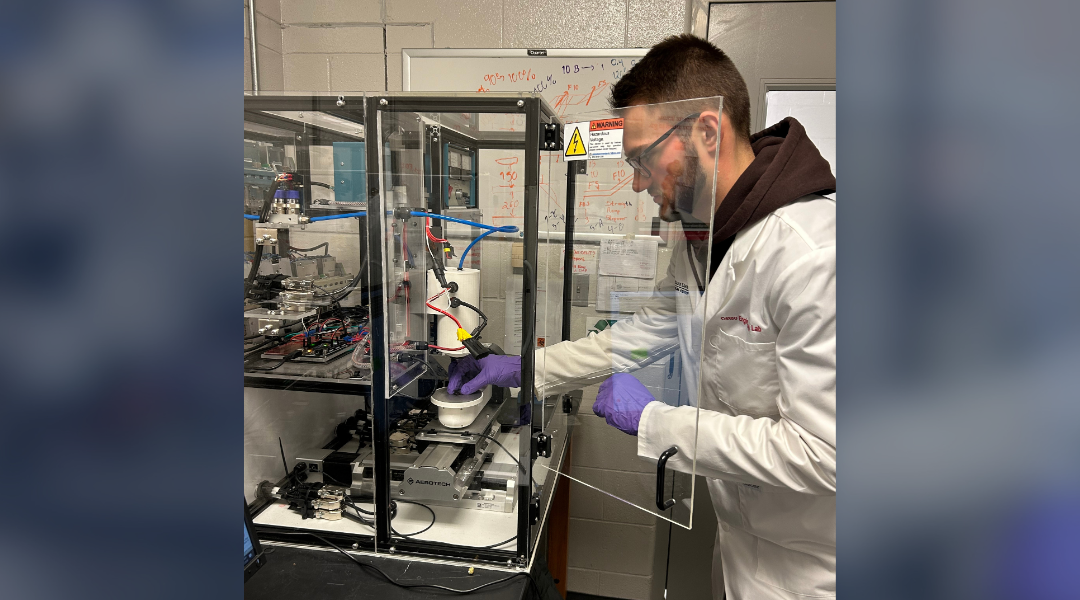
For Evan Gilligan, bioengineering has never been only about what can be built in a lab. It has been about where that work can go — and who it can help.
Gilligan, an incoming Rice University bioengineering Ph.D. student from Toledo, Ohio, arrives at Rice with a research path shaped by global health, medical need and a desire to develop practical technologies for communities with limited access to care.
That motivation began after high school, when Gilligan spent two years in Chad, a country in Central Africa. The experience, he said, changed the way he thought about health care, engineering and the kind of life he wanted to build.
“I was broken and humbled by the reality of the medical need there,” Gilligan said. “I realized that I needed to do everything that I could with my life to do something about that, to improve the living conditions for the people that had become like family to me.”
That experience led him to study biomedical engineering at The Ohio State University, where he explored several areas of research connected by a common goal: improving lives through practical engineering solutions.
At Ohio State, Gilligan worked in tissue engineering, helping develop surgical implants that mimic the properties of native tissues. He also worked on water treatment systems for rural communities in Honduras, focusing on simple approaches to ensure clean water reached areas without reliable access.
He later worked with Design Outreach, a nonprofit organization in Columbus, Ohio, on a negative-pressure wound therapy device designed for use in low-resource settings.
For Gilligan, those projects reinforced the importance of engineering that is not only innovative but usable.
“Being able to travel and being able to go and test what you make and see whether it’s making a difference, whether it’s practical, whether people like using it, and it helps them is very important in the engineering process,” Gilligan said.
Rice entered Gilligan’s story long before he applied to graduate school. As an undergraduate, he began looking for researchers using bioengineering to improve global health and found the work of Rebecca Richards-Kortum, the Malcolm Gillis University Professor, professor of bioengineering and co-director of the Rice360 Institute for Global Health Technologies.
“When I was looking at what I wanted my undergraduate degree to be in, a big motivation in it was from Dr. Richards-Kortum at Rice University,” Gilligan said. “Seeing someone use bioengineering as a way of improving global health helped to validate that that was a good course of study.”
Now, Gilligan said, the opportunity to begin his doctoral studies at Rice and potentially work with Richards-Kortum feels like “a good full-circle moment.”
What stood out most to him about Rice was the combination of high-level research and direct application.
“A big thing that stood out with Rice was just the standard of excellence, that everything’s done at a high standard and is trying to push the boundaries,” Gilligan said. “But then also, especially in Dr. Richards-Kortum’s lab, the direct application to real worlds and knowing that what you’re working on can improve the lives of people that need it.”
That sense of purpose was also evident during the application and interview process. Gilligan said his interactions with Rice faculty felt personal and thoughtful, not transactional.
“When you reach out to professors, you almost wonder if their response is just them being nice,” Gilligan said. “But whenever I did ask questions or anything, it was a very thorough response. It was like, ‘Oh no, she cares.’”
Gilligan was so eager to begin that he moved to Houston early and started working in Richards-Kortum’s lab before the fall semester.
“This is exactly what I wanted to do for what feels like forever,” Gilligan said. “So I was like, why wait to do it? Why not just go start?”
As a doctoral student, Gilligan hopes to use the training and opportunities at Rice to contribute to global health through both research and education. He sees a Ph.D. as a pathway to help communities build capacity and develop solutions from within.
“A big thing that I see as a need in the world of global health is education,” Gilligan said. “A Ph.D. can open opportunities to help them go and teach and educate communities to help provide for themselves rather than being reliant on outside help.”
Outside the lab, Gilligan brings another creative interest to Rice: music. He grew up playing music in church, including keys, synthesizers and sound design, and later became involved in music production. That work eventually helped him start a recording studio in Chad to produce educational materials and record the first audio Bible in local native languages.
Now in Houston, he is looking forward to exploring the city’s music scene while beginning his graduate studies.
For Gilligan, Houston’s size, diversity and proximity to the Texas Medical Center make Rice an ideal place to pursue research with real-world impact.
“Houston, both the size and the diversity of Houston, make it seem like you can do just about anything here,” Gilligan said.
That sense of possibility is what drew him to Rice — and what he hopes will define his time as a graduate student.
“There’s the prestige of Rice and the excellence of the medical center across the street,” Gilligan said. “But then also the humility and openness of people at that same level of excellence being there to respond, and they care if you succeed.”