

I had my first lecturing debut in America, and it was a delight!
This semester, I have been serving as a Teaching Assistant (TA) for Dr. Hayley O’Malley, a Film Studies professor at Rice, and it has been a new pedagogical learning curve for me. From grading students’ papers, to taking attendance and contributing to class discussions, it has been exciting!
Film studies is an interesting aspect of Art History that I was first introduced to last semester. Learning common concepts and technicalities of film, such as canted shots, mise-en-scène, and dolly ins, and applying them to my everyday conversations with film enthusiasts makes it even more enjoyable. Understanding that some gender theories applied by filmmakers are, at times, universal makes film a very relatable form of art. A mirror of society!
My first class in film studies from the previous academic year jump-started my exploration of feminist theories and psychoanalytic concepts. While I could not relate to some theories, which I believe are deeply steeped in Western hegemonies, I could relate to quite a few. For example, I could relate to the heavily contested concepts of the Oedipus and Electra complexes, propounded by Sigmund Freud and Carl Jung, respectively. In these film classes, these theories are extensively discussed using films that mirror them.
Oedipus Complex, derived from Greek mythology, explores the competitive love a boy-child has for his mother. It explains why most men keep “looking for their mothers” in the women they want to marry.
Electra Complex is the opposite. Here, a girl-child is competing with her mother for her father’s attention. Could this explain why we look for our fathers in men? (For those with great fathers). Or how subconsciously, we keep attracting men who are like our fathers?
Both theories have extremities in that these complexes could turn into amorous and dangerous relationships. Sometimes, it could be an indescribable bond between a mother and her daughter, as seen in the film Stella Dallas, and a son and his father.
Each time, we saw a movie that explained these theories through characters and characterizations; they were all Western movies, and I could not relate to them very much. Then, I realized that African feminism and Western feminism are two parallel lines. I may not have done justice to my contribution in that particular class because of my confusion at the time, but my new role as a Teaching Assistant this semester has offered me a golden opportunity to address the lacuna in the Film Studies taught at my school. Yes, we watched Black films, but they are nothing like African films. Our reality is not the same!
When my professor and I discussed my roles for the class and how I would contribute to it, I offered to lecture on African Cinema, specifically Nollywood, since there was no African film in her syllabus. My very benevolent professor embraced the idea. My joy knew no bounds! I was going to lecture on African Cinema, and I had to make a pick!
After consulting with many of my Nigerian friends on which movie would be suitable to introduce to a Western undergraduate class and yet be directed by a female, we finally concluded that Kemi Adetiba’s The Wedding Party (2016) would be the best choice. It just had to be. It was just perfect! A satirical rom-com that addresses numerous socio-economic issues Nigeria has faced since its independence from the British in 1960. It was an ideal choice for so many reasons:
- It was Kemi Adetigba’s debut as a filmmaker, having been a music video director. And yet again, as an influential female filmmaker in a male-dominated field.
- It was a record-breaking blockbuster that skyrocketed Nollywood to the international audience. It was the highest-grossing Nigerian movie at the time with $315,134.
- In a very playful way, Adetiba addressed ethnic wars by carefully avoiding the Northern region (she did not want any troubles). A very smart woman!
- She addressed the economic depression of the time by including a broken oil magnet, a graduate turned “armed robber” and a hustling graduate wedding planner! While addressing patriarchy too!
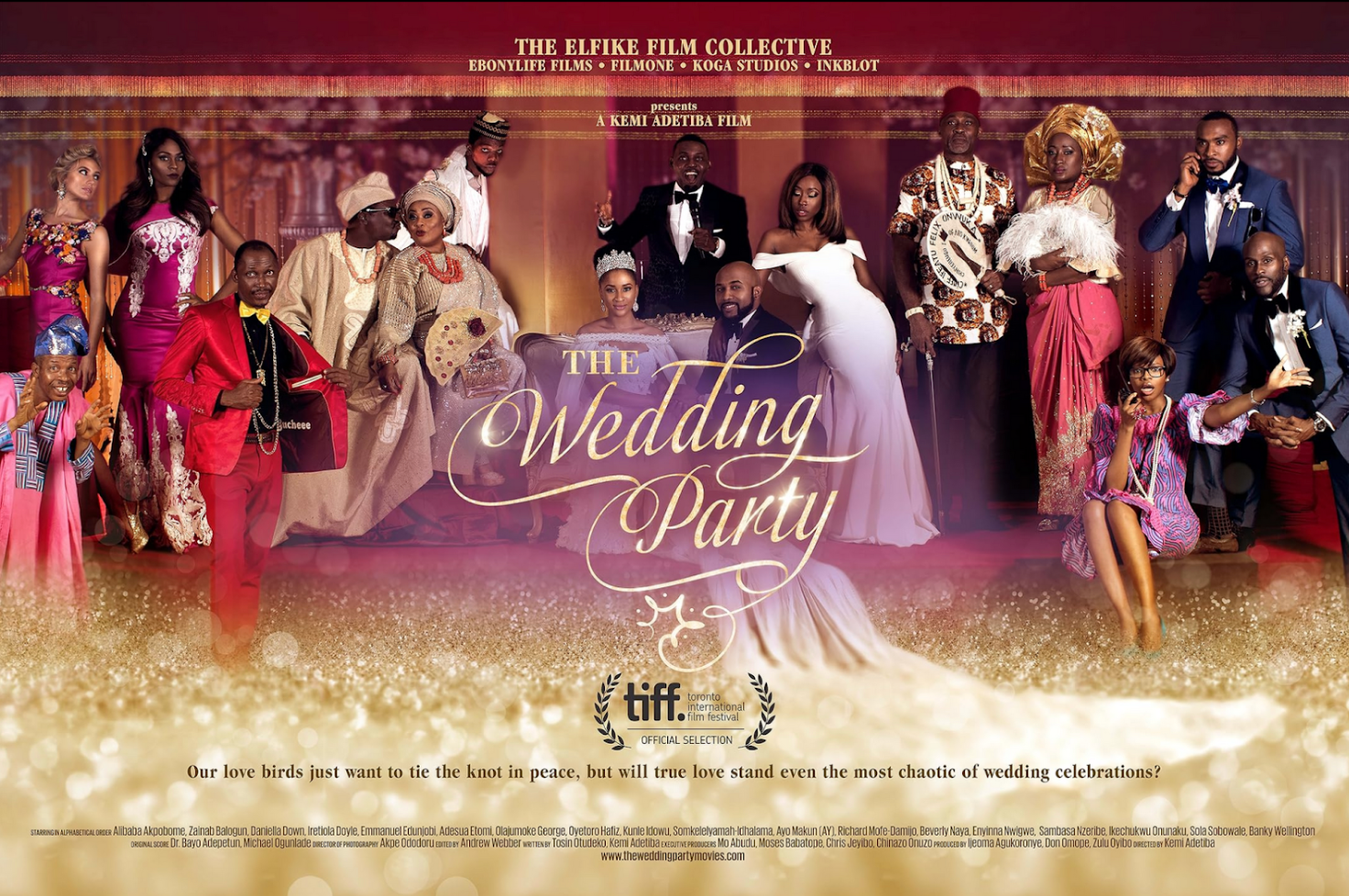
When I was preparing for the lecture, I knew I had to start from the very beginning. I just knew I had to talk about Africa. I showed them the map of Africa, explaining how Cinema first came to Northern Africa in 1896 because it was close to Europe, and how the Europeans told the world what we “looked” like through Cinema. I explained how Cinema finally came to Sub-Saharan Africa a decade later and how Africans reclaimed agency in the 1960s after they got their independence and how a Senegalese filmmaker Ousmane Sembene championed that course through his films. For example- Black Girl (1966). Ousmane Sembene is considered the Father of African Cinema. I told them how Nollywood is very important because it is the second largest film industry in the world after Hollywood. With captivating slides containing descriptive images and videos I explained how we transitioned from celluloids, theatres, to VHS, and CDs, home-videos, cinemas, and streaming giants like Netflix, Showmax and Prime Video and finally, we talked about the film proper!
It was a delight to have a new perspective of The Wedding Party through several Western lenses. While some tropes are universal like the Wicked mother in-law tropes, the run-away bride and the battle of the exes; Patriarchy was not exactly something they could relate to and I explained to them why. I explained that the African society has been patriarchal from time immemorial and that polygamy was our culture till the Westerners came.. They began to understand better, why the men were serially cheating in the movie and why the women were a bit more tolerant of it than in the Western movies. I also explained the concept of the men being the providers, which makes the women have very little say sometimes. I explained Chike-Okeke Agulu’s concept of compound consciousness where we must understand that there is no Africa without the West and why we must learn to co-habit, which the movie portrayed. We are using the same Western weapon- the Camera, to retell our own story. Like Ousmene Sembene said “Africa must learn to tell their own story, else, they will no longer exist,” and Adetiba did a fantastic job in that movie.
As an African, I was particularly interested in their view of Deadre, Dunni’s Oyibo friend who enjoyed African culture. Surprisingly, they thought she did too much! And I told them that we received her character well because she was identifying with our culture, while the other characters were busy adopting the European lifestyle: Greeting the foreign ways and priding themselves in intercontinental dishes. It was indeed a wonderful exchange of insights and a new learning curve for them and myself also, as a debut “guest lecturer,” and I am particularly grateful to Dr. O’Malley for this golden opportunity. In fact, in her own words, she said, “That was a powerful presentation. You are such a natural with this lecturing thing! I am considering inviting you as a guest lecturer in my class next semester if you are open to it!”
Of course, I am more than open to it and I look forward to it!
I had my first lecturing debut in America, and it was a delight!
About the Author:
Osinachi Okafor is from Ebenator Village, Azigbo town in Nnewi South LGA of Anambra state, Nigeria and she is currently a Ph.D student in Art History. She got her B.A in Fine and Applied Art at Nnamdi Azikiwe University, Awka, Anambra State, Nigeria in 2017.
Further Reading:
Houston Sports 101: Houston Astros Basics for New Owls
By: Maximiliano Triana Camacho
Mental Ruts and the Importance of Hobbies
By Anna Lucas
Leveraging a Professional Master's for a JD
By Anna Lucas