
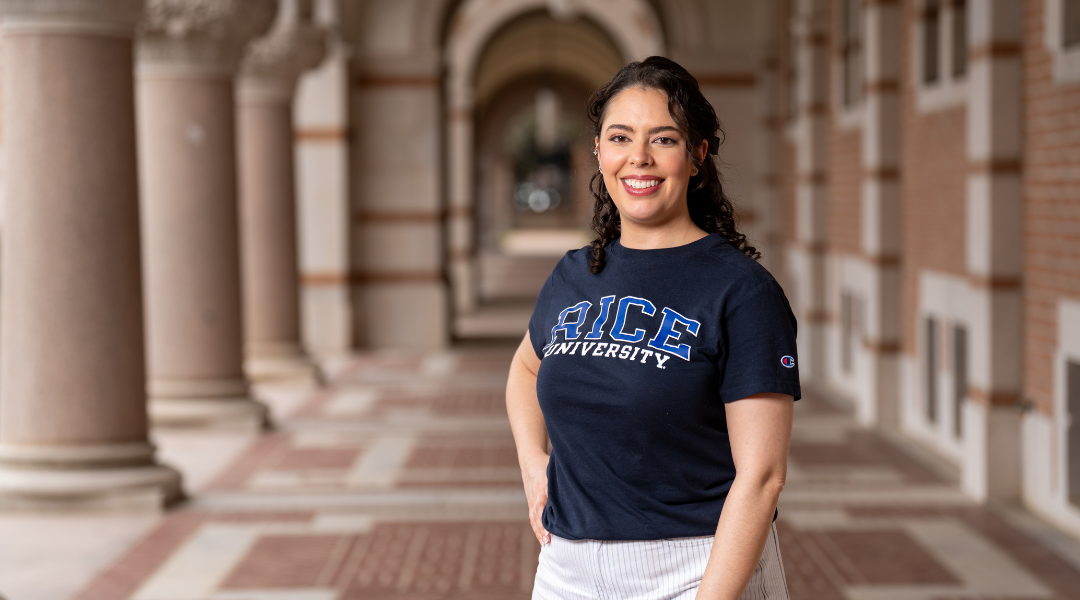
Fernanda Morales-Calva arrived at Rice University with a clear goal: to better understand how human memory works. Five years later, the doctoral candidate in cognitive and affective neuroscience is helping expand the field by examining how memory and brain function may differ across cultures — work that could ultimately improve how scientists detect and study cognitive decline.
Morales-Calva, a fifth-year Ph.D. candidate in the Department of Psychological Sciences, studies human memory and aging. Her research focuses on developing low-cost cognitive tasks to detect subtle age-related changes in memory.
“The lab I work in focuses on research in human memory,” Morales-Calva said. “My doctoral work has focused on the development of novel low-cost memory tasks that are sensitive to age-dependent cognitive decline.”
As her research progressed, Morales-Calva began to recognize an important gap in the field: many studies of aging and Alzheimer’s disease rely on participant populations that do not reflect the full diversity of the broader public. That realization led her to shift part of her research toward understanding cross-cultural differences in memory performance.
Using newly developed memory tasks alongside neuropsychological assessments and high-resolution magnetic resonance imaging, Morales-Calva examines how memory and brain function may vary across populations experiencing healthy aging or early cognitive decline.
Her work is particularly relevant for Latino populations, who are significantly more likely to develop Alzheimer’s disease but remain underrepresented in many research studies.
“Traditional memory measures may not be directly comparable across ethnic groups because they often rely on culturally specific content or testing formats,” Morales-Calva said. “This can mask actual cognitive ability or fail to detect subtle impairments.”
By developing tools that can be applied more broadly across cultural groups, Morales-Calva hopes her research will help address longstanding health equity gaps in cognitive science and Alzheimer’s research.
Morales-Calva’s journey to Rice began while researching graduate programs. During the application process, she attended a virtual coffee chat with Seiichi Matsuda, dean of graduate and postdoctoral studies, which helped solidify her interest in the university.
“When I looked further into the research being done in my area, it became clear that Rice was the right fit for me,” she said.
Her early months in Houston were not without challenges. Morales-Calva arrived during the COVID-19 pandemic and had to navigate the transition to graduate school while adapting to a new country, a different academic system and remote learning.
“My first semester was probably the most challenging,” she said. “We were still in the midst of COVID, having remote classes, and trying to find my bearings in a new city and a new country.”
Over time, she built a strong community at Rice through her research lab and several campus organizations. Morales-Calva became involved with the Fulbright student network, the Latin American Graduate Student Association and the Graduate Student Ambassador Program. She also found an unexpected community space working at Valhalla, Rice’s graduate student bar.
“Being able to mingle with staff, students and professors in a single place has been an incredible opportunity,” she said.
As Morales-Calva prepares to graduate with the Class of 2026, she says she is proud of the journey that brought her to Rice and the research she has been able to pursue.
“I am very proud of knowing that what I was dreaming of five years ago, when I submitted my application, is now a reality,” she said. “I’m proud of myself for proving to myself and others that I belong and can excel doing what I love most.”
While she is currently exploring opportunities for the next stage of her career, Morales-Calva hopes to continue advancing research that broadens participation in neuroscience and improves scientists' understanding of aging and cognitive decline.
Her advice for students beginning their graduate journeys is simple: find balance.
“Everyone’s graduate journey will be different,” she said. “But I strongly recommend finding things that bring you joy outside of your work. Finding a good work-life balance has been essential in keeping me excited about my graduate school journey.”