
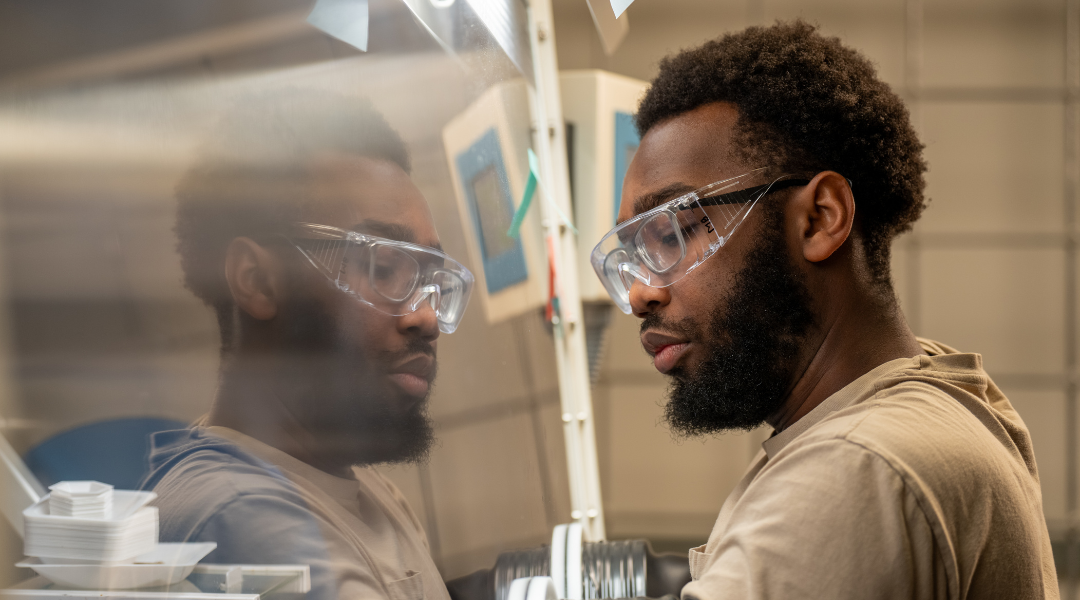
For Damien Cooper, chemistry has always felt like solving a puzzle.
Now a doctoral student in the Chemistry Department at Rice University, Cooper is channeling that early curiosity into research aimed at making chemical processes cleaner and more sustainable. His work focuses on developing environmentally friendly catalysts — substances that speed up chemical reactions — using more abundant and less toxic metals.
Originally from the small town of Batesville, Mississippi, Cooper did not grow up surrounded by research laboratories or visible scientific role models. What he did have was curiosity.
“I was always asking why,” Cooper said. “Why does this happen? How does that work? Chemistry was the first subject where those questions started to make sense.”
He discovered his passion for chemistry in high school and later earned his undergraduate degree at the University of Southern Mississippi. His introduction to Rice came through a summer Research Experiences for Undergraduates (REU) program, where he quickly realized the university was the right fit for graduate study.
“I came for the summer, and I really liked the people and the environment,” Cooper said. “After that, Rice was my top choice.”
At Rice, Cooper’s research centers on sustainable catalyst development in the Yruegas Lab. Many traditional catalysts rely on rare, expensive or environmentally harmful metals. Cooper studies how more earth-abundant elements, such as magnesium and calcium, can be engineered to perform functions similar to those of rarer elements.
“These are elements people think of as everyday materials,” he said. “But with the right chemistry, they can become powerful tools. That’s exciting to me — taking something common and turning it into something useful.”
His work has implications across multiple industries, from pharmaceuticals to materials science, where efficient and sustainable chemical reactions are essential.
Graduate school, Cooper said, has been both rewarding and demanding. As he prepares for his qualifying exam — a significant milestone on the path to doctoral candidacy — he is balancing research, writing and presentations with the daily realities of laboratory work.
“Chemistry is challenging,” he said. “But having a strong support system makes a difference. The people around me — my labmates, my department — they push me to keep going.”
Cooper will be the first person in his family to earn a Ph.D., a milestone he describes as both personal and communal.
“That means a lot to me,” he said. “It’s something bigger than just my own achievement.”
He is also mindful of visibility in the sciences. Growing up in rural Mississippi, Cooper rarely saw scientists who looked like him. Today, he hopes his presence in the lab can help broaden perceptions of who belongs in STEM fields.
“If someone can see me and think, ‘I can do that too,’ then that matters,” he said.
After completing his doctorate, Cooper plans to pursue a career in industry, potentially in catalyst development or pharmaceutical research. For him, chemistry remains what it has always been: a field driven by curiosity, persistence and the satisfaction of solving complex problems.
“It’s like working through a puzzle,” Cooper said. “You keep asking questions until the pieces fit.”