
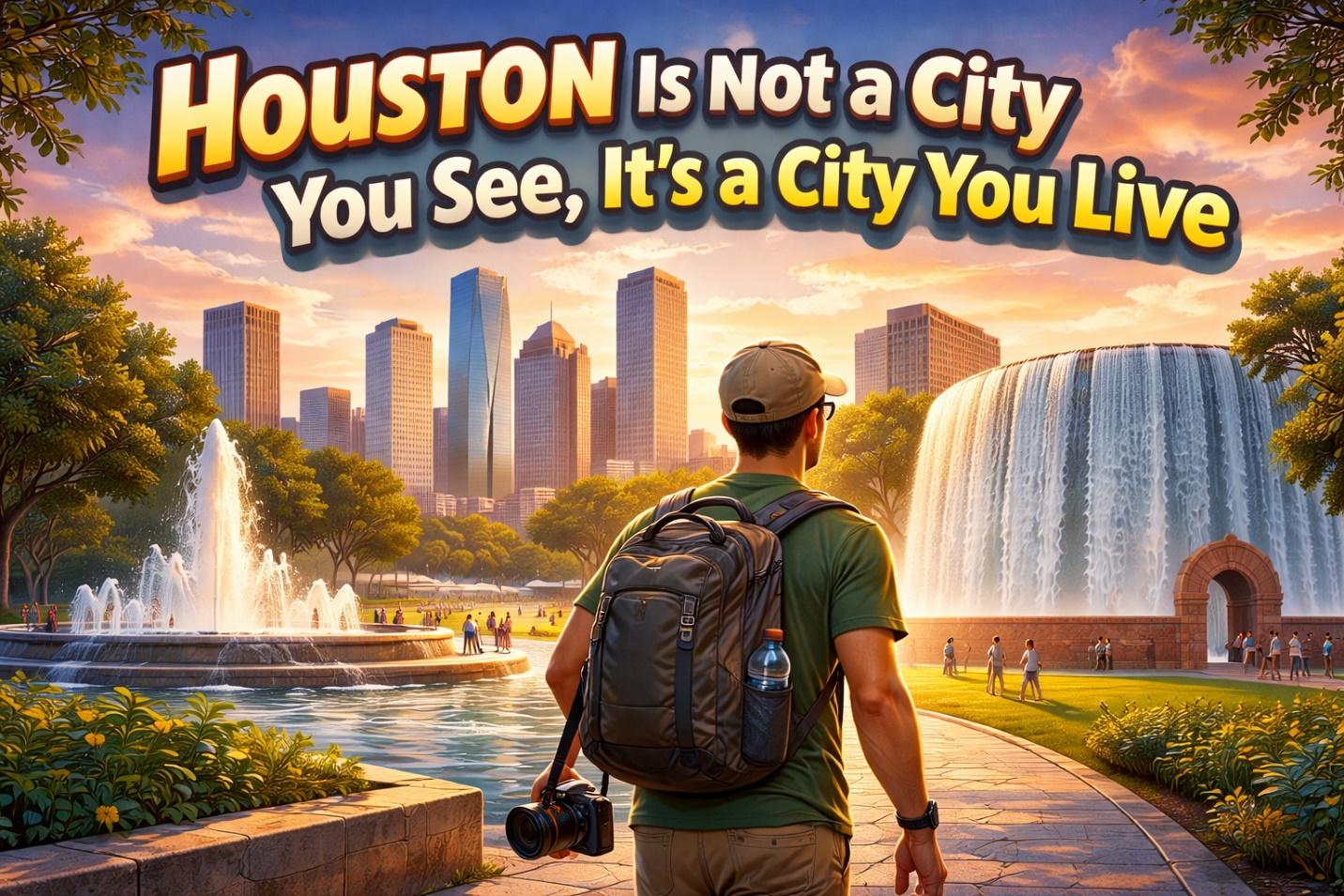
For many international students arriving in Houston, there is an initial expectation shaped by other global cities: that you can walk through the center, see the main landmarks, take a few pictures, and feel you understand the place. This expectation works well in cities like Paris, Rome, or London, where history and geography concentrate iconic monuments into a relatively small area. Houston does not follow this model, and this is often one of the first subtle but important cultural shifts that newcomers experience. The question is not “where are the landmarks?”, but rather “why does the city not feel like it has them?”, and more importantly, “how is it meant to be experienced instead?”
At first glance, Houston can feel like a city without a clear visual identity. There is no single central monument that defines it, no obvious walking route that reveals its essence in a single afternoon, and no straightforward checklist of must-see places that captures the full experience. Even the downtown area, while impressive in its own way, is not the sole cultural or social core. This can create the impression that the city is fragmented or difficult to understand, especially for those used to more compact urban environments. However, this does not mean Houston cannot be enjoyed as a visitor; on the contrary, it offers many places worth exploring. The difference is that tourism here offers only a glimpse rather than the full picture, and it is through repeated visits, routines, and everyday interactions that the city begins to feel cohesive and meaningful.
With that in mind, the goal of this blog is not simply to point out interesting or visually appealing locations, but to frame them through the experiences they enable. In Houston, places are rarely defined only by how they look, but by what happens in them, by the routines they support, the people they bring together, and the moments that accumulate over time. What may initially appear as just a park, a building, or a viewpoint gradually becomes something more personal, a place where you attend events, meet friends, take breaks, or create small traditions. Understanding Houston, then, is less about checking locations off a list and more about recognizing how these spaces become part of daily life.
This becomes clearer when exploring places like Hermann Park, which at first may seem like just a large urban park, but gradually reveals itself as a collection of distinct experiences. The McGovern Centennial Gardens, with their structured layout and waterfall, offer a more intentional and scenic environment, often becoming a place for quiet walks or casual conversations. Nearby, the Miller Outdoor Theatre transforms the park into a cultural space where performances range from concerts by the Houston Symphony to Shakespeare plays, often while picnicking on the hill. The central fountain area feels more social and dynamic, where people gather, study, or simply spend time outdoors, while the Japanese Garden offers a contrasting experience, quieter and more reflective, where the pace slows down, and the surroundings invite a different kind of attention. None of these spaces alone defines the park, but together they create a layered environment that changes depending on how and when you engage with it.
The Galleria is another area of Houston with sharp environmental contrasts. The presence of large commercial structures and high-rise buildings creates a sense of density uncommon in other parts of the city. Within this setting, the Gerald D. Hines Waterwall Park stands out as both a visual landmark and a social space. The waterfall itself is striking and often photographed. Still, the place's experience is shaped just as much by the open grassy area in front of it, where people sit, relax, or gather with friends, and by the imposing building behind it, the Williams Tower, which adds a sense of scale and contrast. It is the combination of these elements, including movement, sound, space, and interaction, that gives the place its character, turning it from a simple visual attraction into a recurring part of the city experience.
A different dimension of the city emerges in places like Buffalo Bayou Park, where the experience is defined less by observation and more by movement. Walking or biking along the trails, the skyline gradually appears and disappears between trees and turns, never fully revealed in a single frame. The experience changes depending on the time of day; early mornings feel quiet and almost private, while evenings bring a steady flow of people exercising, gathering, or simply unwinding after work. It is not a place you visit once and feel you have “seen”, but one you return to, where familiarity builds through repetition, and where the city begins to feel more connected through movement rather than distance.
This sense of discovery through perspective continues downtown, particularly at places like POST Houston, where the rooftop offers one of the most accessible and striking skyline views. From this elevated position, the city begins to feel more cohesive, the spread-out structure becomes visible, and the scale that defines Houston starts to make sense. At sunset, this experience shifts, as the changing light transforms the skyline into something more atmospheric and immersive. People gather not only to take photos, but to spend time, to talk, to pause, and to take in a moment that feels shared. It is less about seeing the skyline once and more about returning to it, at different times and with different people.
Even within our own Rice University, there are places worth exploring beyond our beautiful campus. James Turrell's Epiphany installation changes meaning over time. The first visit is usually driven by curiosity, seeing the structure, watching how the light shifts, and trying to understand what makes it special. But over time, it becomes something else: a spot you visit between classes to relax, where you sit with friends without a plan, or a quiet place to unwind at sunset after a busy day. It’s not just a campus landmark; it becomes part of your routine, your experience, and eventually, a memory of being here.
What emerges from all of this is a different way of understanding the city. Houston does not reveal itself all at once, and it does not ask to be completed like a checklist. Instead, it invites you to return, to repeat, and to build familiarity over time. The places that stand out are not only those that look impressive, but those that become meaningful through use, through shared moments, and through the small routines that define everyday life. In that sense, the value of the city is not only in what it offers to be seen, but in what it allows you to experience. And it is through that process, gradual, sometimes unexpected, and often personal, that Houston becomes more than just a place you visited, and instead becomes a place you lived.
Welcome and enjoy the city!
MSc. Manuel Carmona Pichardo
PhD Candidate Chemistry Department
GPS Graduate Ambassador
Jones Lab
