
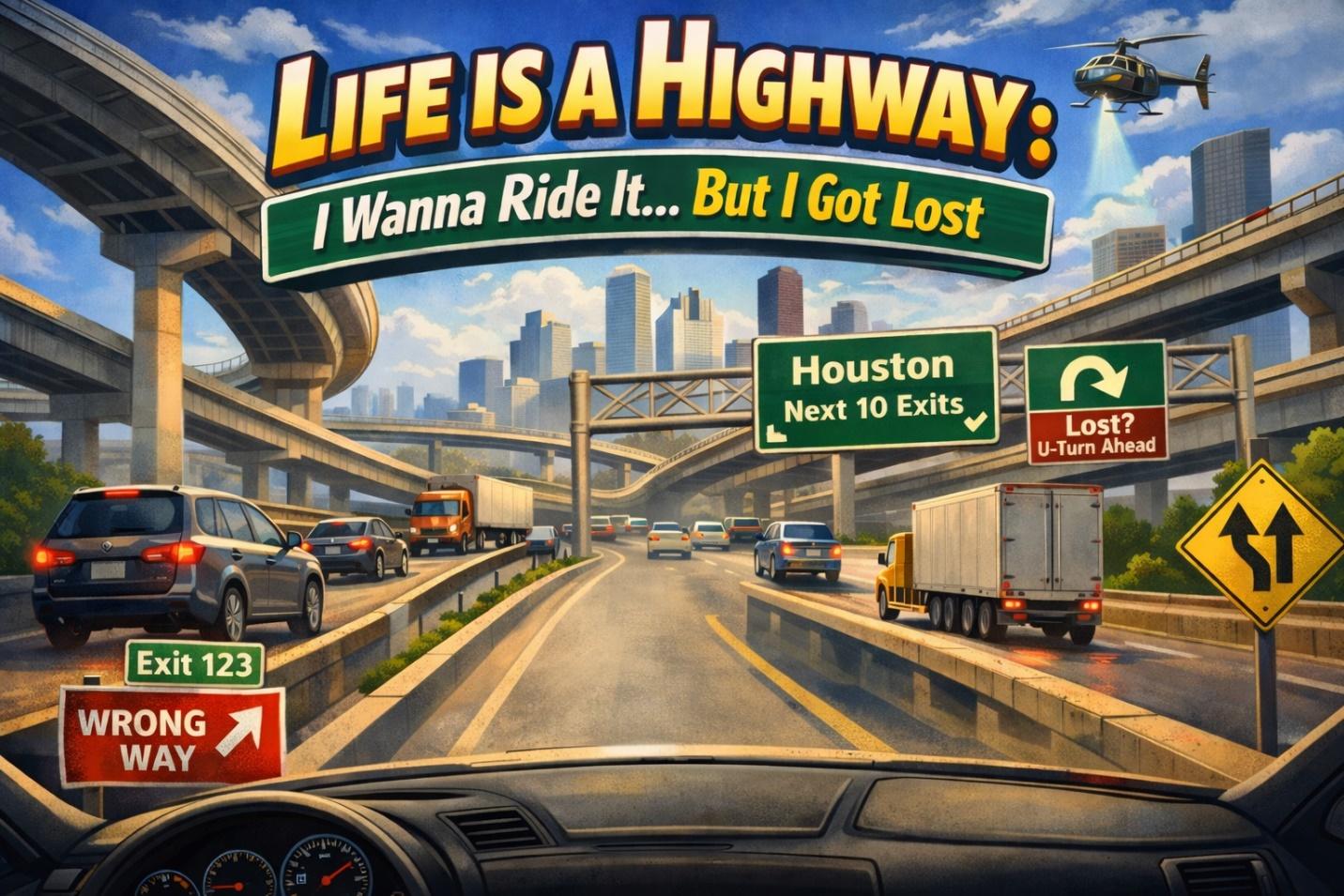
Imagine arriving at George Bush Intercontinental Airport as a new graduate student, exhausted after a long international flight, excited to start a new chapter, and eager to reach your new home. You pick up your luggage, hop into a car, open your GPS, and start driving. Within minutes, your focus shifts from your classes or research to figuring out what’s happening around you. Lanes multiply in every direction, cars move swiftly and confidently, signs come and go before you fully notice them, and what feels like a simple drive turns into navigating a jungle of concrete, speed, and choices. This often marks the first real experience of life in Houston, and for many international students, it’s both overwhelming and unforgettable.
What initially seems like a simple road system quickly reveals itself to be much larger, faster, and more complex than expected. The idea of driving in Houston is often underestimated, especially by those from cities with strong public transportation, but navigating the highways here becomes a vital skill rather than an option. In many ways, Houston’s highways are a direct extension of the broader Texan lifestyle; they reflect scale, speed, and independence, but also demand attention, planning, and confidence.
First Impression: What Is Going On?
As an international student, I'm more used to traveling between cities on highways than driving within the city to get almost anywhere. The first time you fully get on a Houston highway, the experience can feel confusing. Multiple lanes stretch across what seems like endless space, cars move at high speeds, and exits come quickly and sometimes unexpectedly. The Houston freeway system is built to handle large volumes of traffic, which prioritizes efficiency over simplicity. For a newcomer, this feels like everything is happening too fast, with little time to hesitate. Unlike smaller or more crowded cities, where traffic naturally slows down, Houston's highways require drivers to make quick decisions and stick with them.
Understanding the logic behind the chaos
To move from confusion to confidence, it helps us to understand that Houston’s highways are not random; they follow a structure that, once recognized, actually becomes logical. Here is a map to help you visualize the network:
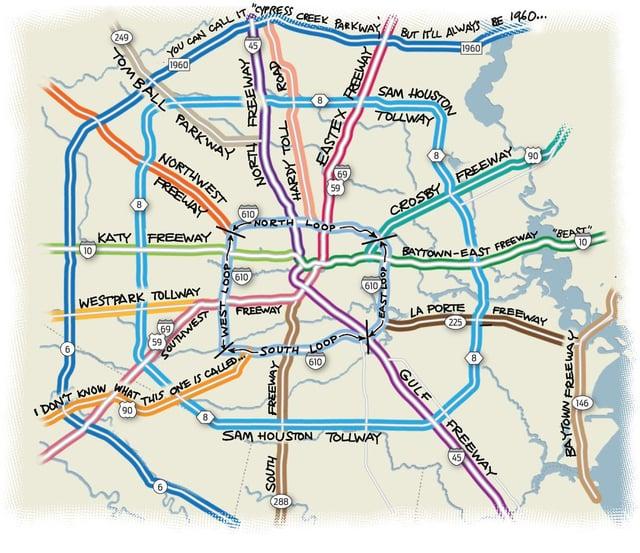
The system is organized around a series of major interstate highways and loops that define how the city expands and how people move within it. At the center lies Interstate 610, often referred to simply as “the Loop”, which circles the core of Houston and separates what locals call “inside the Loop” from the outer areas. This distinction is not just geographical; it often reflects differences in lifestyle, density, and even housing prices.
Radiating outward from this central loop are some of the most important highways you will encounter early on. Interstate 45 runs north to south, connecting downtown Houston to Dallas in one direction and Galveston in the other, making it a key route for both daily commuting and weekend trips to the coast. Interstate 10 stretches across the entire city from east to west and is one of the longest highways in the United States, linking Houston to cities like San Antonio and beyond. Another major artery is U.S. Highway 59, also known in parts as I-69, which cuts diagonally through the city and serves as a critical connector between different regions.
Beyond the central loop, additional rings expand outward, almost as if Houston is built in layers. Beltway 8 forms a larger ring around the city and includes both free sections and toll roads, while Texas State Highway 99, also called the Grand Parkway, represents an even wider outer loop that is still expanding. These concentric highways are designed to distribute traffic and provide alternative routes, allowing drivers to bypass congested areas or travel between suburbs without entering the city center.
An important and often overlooked feature of this network is the presence of feeder roads, which run parallel to many major highways. These roads act as a buffer between local and high-speed traffic, allowing drivers to enter and exit the highway system more gradually while also providing access to gas stations, restaurants, and shops. For newcomers, understanding feeder roads can transform the driving experience, since they offer a way to recover from mistakes, reposition for exits, or avoid heavy traffic without fully committing to the main lanes.
The Advantages: Efficiency at Scale
Once the initial shock wears off, the benefits of this system become clear. Houston’s highways are designed to move many people across long distances fairly quickly. Given the city’s size, travel times can be surprisingly reasonable when traffic flows smoothly. The network is highly connected, offering multiple route options between two points, and this flexibility proves valuable for daily commuting or avoiding congestion. The addition of feeder roads adds another layer of functionality, allowing drivers to access businesses, make stops, or reroute without constantly entering and exiting the main highway. Over time, this setup fosters a sense of independence, allowing you to choose how to navigate the city based on the time of day, traffic, or personal preference.
The Disadvantages: Complexity and mental burnout
At the same time, this efficiency involves trade-offs. The system's complexity demands constant attention, especially in unfamiliar areas. Drivers need to process signs quickly, anticipate lane changes early, and stay alert to fast-moving traffic from multiple directions. Mistakes, such as missing an exit, can lead to long detours, especially during rush hour. Relying on highways also limits options for those without access to a car, making mobility harder compared to cities with widespread public transportation. Additionally, traffic jams, particularly during rush hour, can turn a normally quick commute into a slow, frustrating experience, highlighting the importance of timing and route planning.
The “One More Lane” Philosophy
A distinctive and often humorous aspect of Houston’s highway culture is what could be called the “one more lane” philosophy. The idea is simple: when traffic becomes a problem, the solution is to add another lane. In practice, this has led to highways that expand to impressive widths, sometimes with eight or more lanes in a single direction. Over time, this approach has become something of a meme, reflecting both the ambition and the limitations of solving congestion through expansion alone. For newcomers, it can be surprising that even extremely wide highways can still experience heavy traffic, highlighting that demand often grows alongside capacity. While this philosophy contributes to the scale that defines driving in Houston, it also illustrates how infrastructure and behavior continuously adapt to one another.
Practical Tips, Small Realities, and Final Thoughts
Adapting to Houston’s highways becomes much easier once you develop a few practical habits. Using GPS is not optional; it’s essential, especially because it provides lane guidance and real-time updates that help reduce last-minute decisions. It’s always better to position yourself in the right lane earlier than you think necessary, as exits can appear quickly and sometimes from unexpected directions. If you’re unsure, staying in the middle lanes gives you more time to react and adjust. An important and often overlooked detail is the role of feeder roads, which can be used strategically to avoid traffic, access services, or recover from a missed exit without stress. Another useful insight is that missing an exit is not a failure but a normal part of driving in Houston; the system is designed to let you reroute easily, even if it adds a few extra minutes.
Over time, what initially feels like chaos becomes a predictable rhythm, where speed, spacing, and decisions start to make sense. Ultimately, navigating Houston’s highways is less about mastering every road and more about adapting to a different driving logic—one that rewards anticipation, confidence, and a willingness to learn by doing.
Welcome and good luck!
MSc. Manuel Carmona Pichardo
PhD Candidate Chemistry Department
GPS Graduate Ambassador
Jones Lab
