

Long after the sun sets over Houston, a small team of Rice University researchers is out chasing the city’s noisiest neighbors — though the ones humans can’t always hear.
Armed with an ultrasonic microphone taped to the roof of a car, graduate student Alexandria Shockney drives through the city collecting the invisible sounds of bat calls, data that could shed light on both urban ecology and human health.
“This is our mobile acoustic monitor,” Shockney said. “Bats like to speak at a frequency that’s much, much higher than what we can hear. This microphone slows things down and brings it to a level that we can interpret.”
Shockney, a second-year doctoral student in the Rummel Lab, studies the migration physiology of the Mexican free-tailed bat, an iconic species whose nightly flights paint ribbons across the Houston skyline. Her project tracks how bats use different parts of the city — near tree canopy, water or dense human areas — and how seasonal changes alter those behaviors.
Houston, she said, is the perfect place to study them.
“There’s a huge roost colony at Waugh Bridge, about 300,000 bats,” she said. “A colony that size eats about 2 tons of insects every night. They save Texas farmers millions of dollars in pesticide control each year.”
Shockney’s work combines field biology, physiology and biomedical insight. Before arriving at Rice, she worked as a cardiovascular surgical nurse, a background that informs her fascination with how bats endure extreme physical stress.
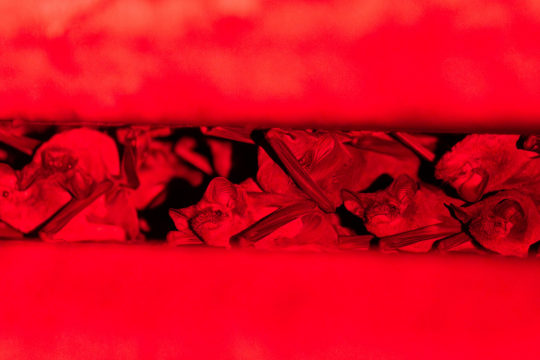
“These bats have incredibly high energetic demands for migration, and yet they somehow survive these incredible journeys year after year,” she said. “I’m hoping that by researching how they achieve that, we can apply some of that knowledge to human health.”
In addition to her research, Shockney mentors undergraduate and community college students through collaborations with San Jacinto College, the Houston Area Bat Team and local wildlife rehabilitation groups.
“My day-to-day is project management and mentoring,” she said. “You never know what spark will ignite a love for science in someone.”
Her adviser, assistant professor Andrea Rummel in the Department of Biosciences, said Shockney’s path from nursing to bat biology highlights the creativity and initiative that define Rice graduate education.
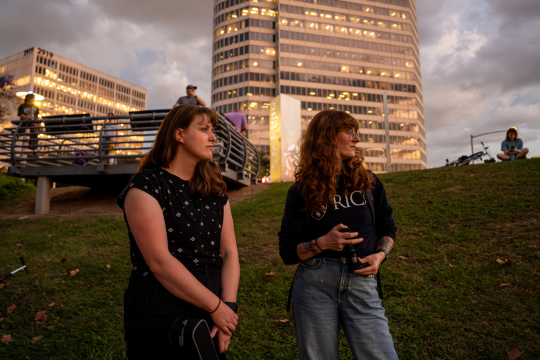
“Alexandria immediately hit the ground running,” Rummel said. “She basically designed this project from the ground up. She’s doing excellent science, but she’s also communicating that science — reaching out to the public and showing how vital these animals are to our ecosystem.”
Rummel said Houston offers unparalleled access for bat research and a community that’s surprisingly bat-friendly.
“Bats are important to us here in Houston and across Texas,” Rummel said. “Alexandria’s work helps people understand that importance, both ecologically and economically.”
For Shockney, that connection between people and science is what keeps her out on Houston’s bayous at dusk.
“They’ve had a bad stigma for years,” she said, “but I think Houstonians are starting to appreciate our neighborhood flyers.”