
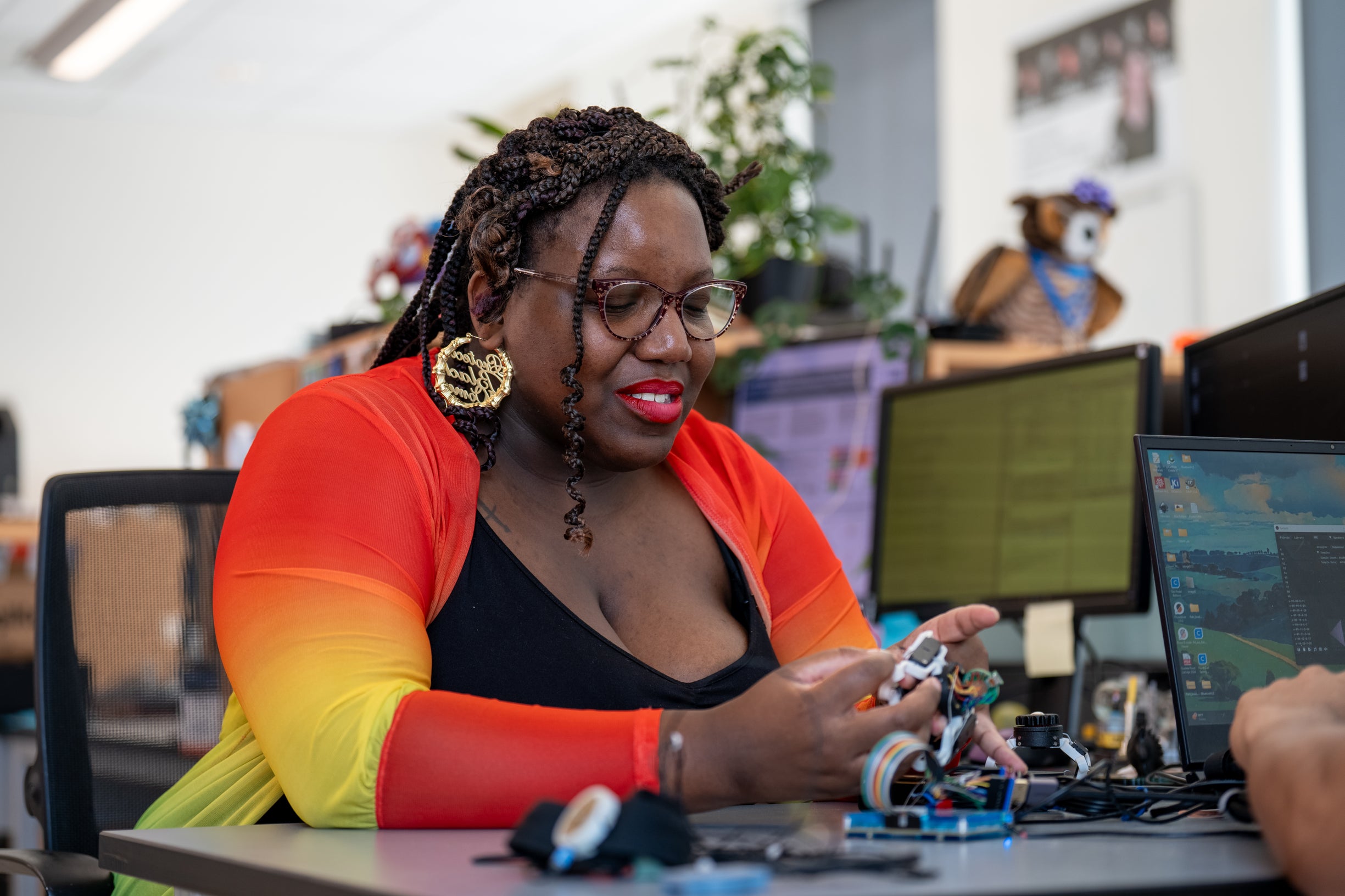
Finding the right resources in graduate school can shape more than academic success — it can influence a student’s wellbeing, leadership path and sense of belonging. For Daziyah Sullivan, a sixth-year Ph.D. candidate in mechanical engineering at Rice University, discovering community and mentorship proved just as transformative as her research.
Sullivan began her academic journey at Florida Agricultural and Mechanical University (FAMU), a historically Black university she proudly calls “the baddest HBCU in the land.” The experience grounded her in a culture where community was central to student life — something she carried with her into graduate school.
At Rice, Sullivan works in the Mechatronics and Haptic Interfaces Lab under the mentorship of mechanical engineering professor Marcia O’Malley. Her research focuses on haptics, technology that simulates touch through vibration or force feedback, and how it can support mental health.
“I study haptics, think about augmented touch, and how it can support mental health, particularly exploring how vibrations can be emotionally evocative,” Sullivan said.
Her work centers on two priorities: wellbeing and accessibility. Sullivan asks how technology can be designed to quietly support people in everyday moments.
“How can we make mental-health technology more discreet?” she said. “How can it fit into someone’s everyday life, like a watch or a wristband, while still providing comfort and support?”
By studying how specific vibration patterns influence emotional responses, Sullivan hopes to create tools that integrate seamlessly into daily routines, reducing stigma while expanding access to care.
Sullivan began her doctoral studies in 2020 at the height of the COVID-19 pandemic. The transition from an HBCU environment rooted in visible, daily community to a predominantly white institution navigating lockdown created challenges.
“Coming from an HBCU, where community is culture, it was hard at first to find my place,” she said.
She found a connection through the Black Graduate Student Association (BGSA), became involved, and later served in leadership roles. The organization provided affirmation and support during a period marked by isolation.
“Support and representation matter,” Sullivan said.
In her second year, Sullivan served as Wellbeing Director for the Graduate Student Association, focusing on initiatives that encouraged graduate students to prioritize mental health and connection. During her time in that role, she helped bring the Graduate Wellbeing Peers program back up and running — a peer-support initiative that connects graduate students with trained student volunteers for confidential conversations and resource guidance.
The program, available through the Graduate Student Association, continues to provide accessible support for students navigating the challenges of graduate life.
Sullivan’s leadership extended beyond student governance. She also completed Rice’s Certificate in Teaching and Learning, preparing for her goal of becoming a professor. She hopes to build classrooms that prioritize inclusion and holistic student support.
“Grad school challenged me in ways I didn’t expect — as a researcher, a leader and a future educator,” she said. “I’ve learned how to ask better questions, how to pivot when needed and how to grow — even when things feel uncertain.”
During Black History Month, Sullivan reflects on the expectations that often accompany being a Black scholar in higher education.
“Being Black and a graduate student can sometimes feel like you’re expected to embody your ancestors’ wildest dreams — to be resilient, to personify excellence and to constantly give back,” she said.
While she honors that legacy, she encourages students to define their own measures of success.
“I implore you to take time to recognize what this journey means for you — and only you — and to grow into your truest self.”
That perspective shapes the advice she shares with prospective students.
“You are the catch,” Sullivan said. “The question isn’t just whether the university wants you. It’s whether the university has what you need.”
For her, that meant access to wellbeing resources, supportive faculty mentorship and a collaborative lab culture. She recalls noticing something simple but meaningful during her visit: people in the lab were smiling and engaging with one another.
“That’s where I knew I could thrive,” she said.
As she prepares to complete her doctorate, Sullivan’s work stands at the intersection of engineering and empathy. Through research grounded in accessibility and leadership rooted in community, she is advancing technology while keeping human wellbeing at the forefront.
“My journey is about making sure I leave this experience as whole as I entered it — and helping others do the same,” she said.