

When Barbora Malikova arrived at Rice University to begin her Master of Architecture, she had already competed on the world’s biggest athletic stage.
An Olympic sprinter representing the Czech Republic, Malikova brought international experience and years of elite-level training to Houston. What makes her journey at Rice distinctive is not just her athletic resume; she decided to pursue one of the nation’s most rigorous graduate architecture programs while continuing to compete in NCAA Division I track and field.
At Rice, she found a place where athletics and academics don’t compete for her focus - they strengthen each other.
“I was ready to step away from athletics for my Master of Architecture, but at Rice I found the right coach and team to keep pushing my limits without compromising my education,” Malikova said.
Malikova competed in the 400 meters at the Tokyo 2020 Olympic Games after years of intensive training, overcoming injuries and physical setbacks. She later earned her undergraduate degree in industrial design at Virginia Tech before applying to graduate architecture programs across the United States.
The Rice School of Architecture stood out.
Consistently ranked among the top architecture graduate programs in the nation, Rice offers a highly selective, studio-intensive curriculum with small cohorts and close faculty mentorship. Malikova was awarded full tuition support through the architecture program and later joined the Rice track and field team, where athletics covers her living expenses.
“I was applying to strong programs, but when I learned more about Rice, it became clear,” she said. “The education is elite, but the community is personal. You’re not just one of hundreds.”
Malikova trains seven to eight times a week during the competitive season, balancing weightlifting, sprint sessions and recovery with the demanding workload of the architecture studio.
Unlike larger athletic programs where schedules often revolve entirely around sport, Rice’s environment prioritizes academic integrity alongside athletic excellence. Architecture studios require mandatory hours and collaborative work, meaning careful time management is essential.
“Track and field has taught me discipline,” Malikova said. “Architecture requires the same mindset - consistency, resilience and staying on top of my schedule.”
Malikova experienced the scale of a major athletic program during her undergraduate years. At Rice, she says, the difference is the culture.
“At a bigger school, you can feel like one of many,” she said. “Here, coaches and professors genuinely care how you’re doing - not just your performance, but how you feel.”
For students prioritizing both academic reputation and athletic opportunity, she believes Rice offers something distinctive.
“If someone wants a place that values education first and still supports great sport, Rice is a strong choice,” she said.
The decision is paying off on the track as well.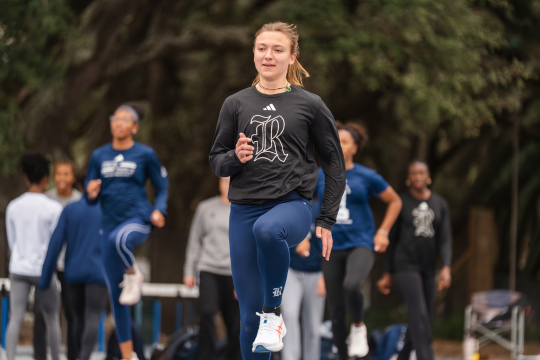
Malikova recently etched her name into the Rice record books, breaking a 23-year-old school mark in the 400 meters while continuing to thrive in one of the nation’s most rigorous graduate architecture programs.
Competing at the Tyson Invitational in Fayetteville, Malikova set a new Rice indoor 400m record with a time of 51.84 seconds, surpassing Allison Beckford’s 52.16 mark set in 2002 - a time that clinched an individual national championship for the Owls. In doing so, Malikova also broke the American Conference indoor 400m record.
A native of the Czech Republic, Malikova also values Rice’s international graduate community. Half of Rice graduate students come from outside the United States, creating a globally connected campus culture.
“A lot of my friends here are international students,” she said. “It feels like a global environment where people are serious about what they’re studying.”
That global perspective aligns with her long-term goals. Malikova hopes to combine architecture and design in her future career, potentially working internationally. She says Rice has a strong alum network both in the U.S. and abroad, and that has reinforced her confidence in that path.
“The Rice community extends far beyond campus,” she said. “That network matters.”
Malikova says it was only recently that she saw how much athletics had shaped her, and how much it parallels the rigor of academic life.
“Being a student-athlete gives you structure,” she said. “It teaches you how to push through hard moments and how to focus on what’s important.”
With two years of NCAA eligibility remaining, she plans to continue competing while advancing in the architecture program, taking her career one season and one studio project at a time.
At Rice, she’s learned that striving for excellence isn’t limited to one field.
“You can push yourself to the limits athletically,” she says, “and still shape environments with intention and meaning.”