
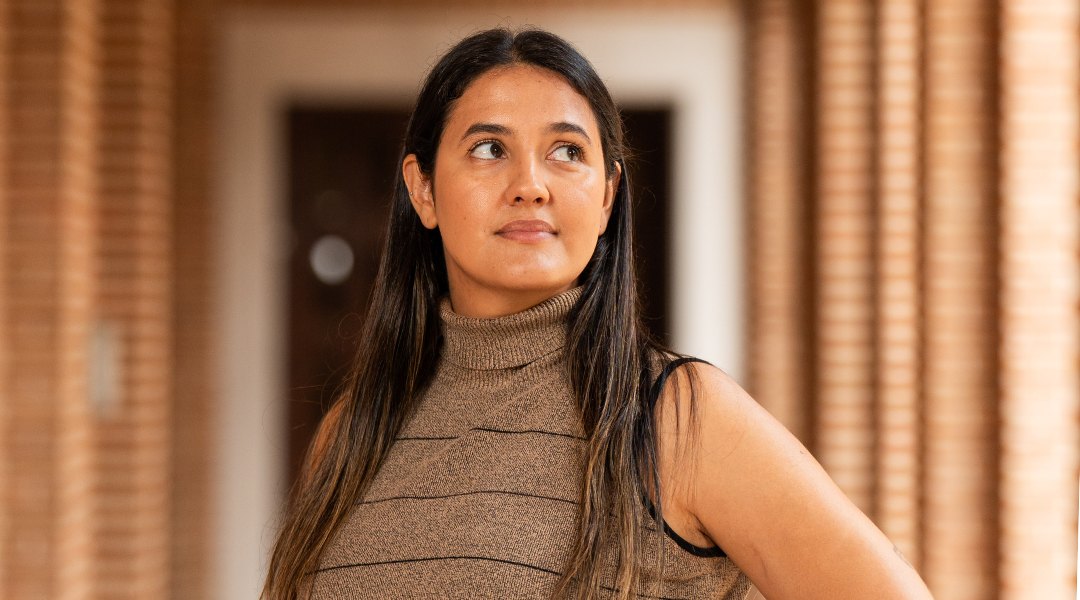
Melissa Hurtado Nuez, a second-year Ph.D. student in sociology at Rice University, has been named a 2026 Paul and Daisy Soros Fellow, a prestigious national fellowship that supports outstanding immigrants and children of immigrants pursuing graduate education in the United States.
Hurtado Nuez, who immigrated to the United States from Cuba as a child, is one of 30 recipients selected from more than 3,000 applicants for the 2026 fellowship class. The award provides up to $90,000 in funding over two years and connects fellows with a multidisciplinary community of scholars, professionals and mentors.
At Rice, Hurtado Nuez studies migration, health and guns in society, with a focus on how structural inequalities shape migrant health and well-being in the United States. Her work also examines the strategies immigrants use to navigate barriers to safety, belonging and opportunity.
“Broadly, my research focuses on how structural inequalities shape migrant health and well-being in the United States, as well as on the strategies immigrants deploy to navigate and overcome these barriers,” Hurtado Nuez said.
Her dissertation will examine how Latin Americans’ firearm beliefs and practices are shaped through the migration process. She hopes the research will help inform policy around immigrant incorporation, public safety and the ways immigrant communities construct pathways to protection and belonging.
“Latinos, especially those who are immigrants, remain really underrepresented in gun research, and it is unclear how guns may pose problems and solutions for this community,” she said. “For my dissertation, I plan to examine how Latin Americans’ firearm beliefs and practices are shaped through the migration process to better inform policy on immigrant incorporation and public safety.”
Hurtado Nuez was born in Havana, Cuba. Her family’s journey to the United States began in 1994, when her father pushed a makeshift raft off Havana’s eastern coast and began a dangerous seven-day journey toward Florida. After seven years of separation, Hurtado Nuez joined her father in Florida in 2001.
Her early years in the United States were shaped by economic uncertainty as her parents worked physically demanding jobs and the family moved frequently to keep up with rising housing costs. Eventually, they settled in Ocala, Florida, where her father managed a horse farm that provided housing. As a child, Hurtado Nuez often served as her family’s primary translator, helping with administrative tasks.
Those experiences shaped the questions that now guide her scholarship.
From an early age, Hurtado Nuez saw how public narratives, policy regimes and economic conditions could shape immigrants’ access to safety, resources and belonging. She later became the first in her family to graduate from college, earning a degree in statistics from Hunter College before beginning her career as a data analyst at Bloomberg.
The COVID-19 pandemic redirected her path. As anti-immigrant rhetoric intensified and her parents faced illness without health insurance or access to certain forms of relief, Hurtado Nuez returned to graduate school to study the social processes that shape immigrant well-being in the United States.
She earned a master’s degree in Global and Sociocultural Studies from Florida International University, where her thesis examined the beliefs and practices of Latino and Caribbean immigrant gun owners in Florida. Her research found that, for some immigrants, exercising Second Amendment rights can become a way to assert belonging and seek protection amid hostility. That work earned her an Emergent Scholar Fellowship from Arizona State University’s BRIDGS Center.
Now at Rice, Hurtado Nuez uses both qualitative and quantitative methods to examine migration, health and public safety. She is an active member of the quantitative methods working group and collaborates with faculty and graduate students on research across these areas. One of those projects resulted in a first-author publication in Social Science Research. Her work has also been selected for presentation at the Guns in Society Symposium and the Population Association of America.
Hurtado Nuez said the Soros Fellowship will provide critical support as she continues building her research agenda.