
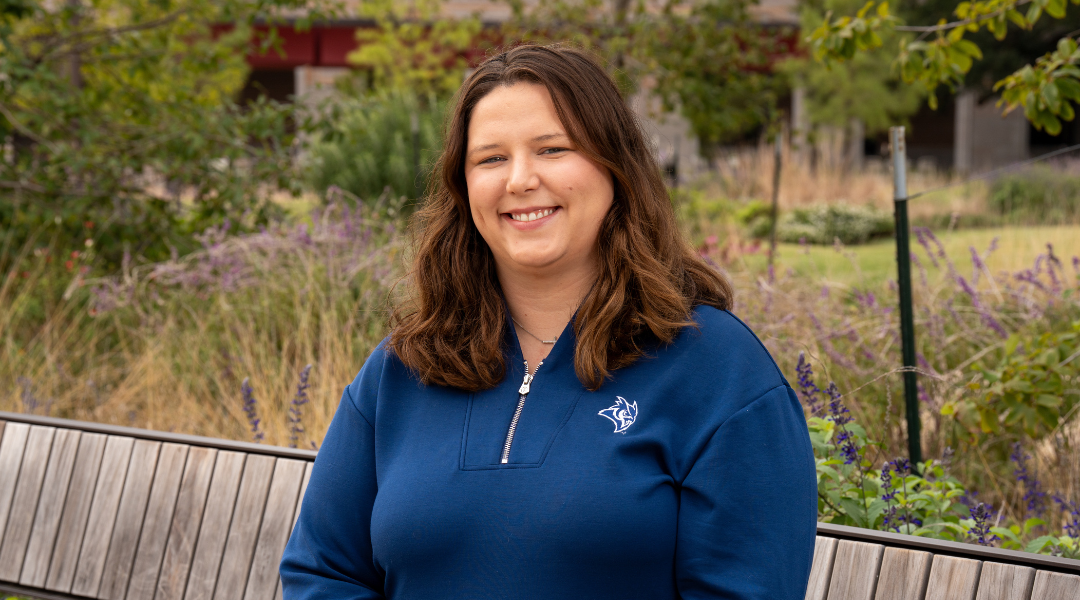
For chemistry Ph.D. candidate Carly Graverson, graduating from Rice University marks the culmination of five years of scientific discovery, personal growth and community building that began with an unexpected invitation.
Graverson was an undergraduate planning for medical school when she discovered a love for research. After earning the Goldwater Scholarship, she was invited to present her work at Rice’s Gulf Coast Undergraduate Research Symposium (GCURS) — a visit that ultimately reshaped her future.
“I immediately loved the community at Rice,” she said. “Professors were giving thoughtful feedback to undergraduates. It wasn’t something I expected to see from an R1 institution, and it made me feel like this was a place where I could grow.”
Graverson joined the chemistry Ph.D. program in 2020, arriving during the early months of the pandemic. Despite remote classes and virtual orientations, she said the department worked hard to maintain connection. Zoom happy hours, online social events and creative gatherings helped her feel grounded during an uncertain time.
“Even in the face of adversity, there was still community being built,” she said. “As I progressed, I knew I wanted to help create that same sense of belonging for new students.”
During her time at Rice, Graverson became involved with the Chemistry Graduate Student Association, Grad STRIVE, the Doerr Institute and the Office of Graduate and Postdoctoral Studies, contributing to student support and leadership initiatives across campus.
Her research centers on gold nanoparticles, microscopic structures used in applications ranging from stained glass to modern diagnostics. “The pink line you see on a pregnancy test is actually the color of gold nanoparticles,” she said.
Graverson studies the molecules, or ligands, that attach to these particles and influence how they grow and interact in solutions. Her work revealed that certain nanoparticles can create molecular complexes that are difficult or impossible to synthesize through conventional methods.
“Discoveries like this open new pathways for catalysis and energy-efficient reactions,” she said. “In today’s energy climate, finding cleaner and more efficient ways to produce materials is incredibly important.”
While her scientific achievements shaped her graduate career, Graverson says the most transformative lessons extended beyond the lab.
“I’ve grown scientifically, but the bigger change has been learning how to think,” she said. “Research teaches you to question assumptions, to test ideas and to stay curious. That mindset is something I’ll carry with me into my career.”
As she prepares to graduate, Graverson reflects on Rice as a place defined not only by its research excellence, but also by its people.
“The people here are what make Rice special,” she said. “I’ve been surrounded by mentors, friends and colleagues who care about me as a scientist and as a person. Graduation doesn’t feel like an ending — it feels like a beginning built on everything this community helped me become.”