
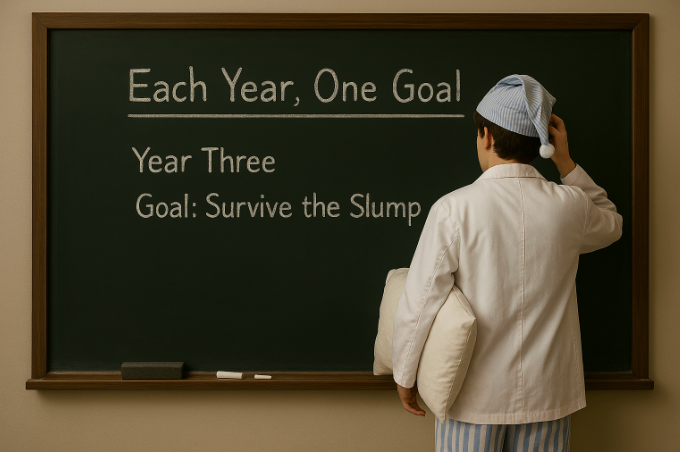
The PhD is a long journey full of ups and downs. This sounds cliché (big warning, this blog will be full of them) but in my opinion, the PhD is the ultimate example of the expression “it’s not a sprint, it's a marathon”. As a fifth year and, hopefully, finishing my grad school journey during this school year, I tend to talk with a lot of younger students who are just starting or are in the middle of their PhD about their experiences. I often share with them some of the expectations I had or the good and bad things I’ve faced as I look back at my journey. I had one big realization I want to share with you guys through this blog. I concluded that “PhD can be summarized in the fact that every school year has one clear goal.. This is a very simple and very loose way to describe it and yes, I’m skipping a lot of the small details that happen throughout the process, but if we step back and look at the big picture, I think you’ll get what I mean. For the rest of this blog, I’ll go through each of the five years (or so) that it takes to complete a PhD and explain what I think is the objective of every year. My goal is to help students that are currently anxious about the future years, those who are a bit lost and lack the motivation of what to do next and/or students who are looking for a broad idea of what the PhD journey is, and try to answer some of the questions they might have or help them focus on what they could be focusing right now and even planning for the future. With that long winded intro, let’s continue with the series and talk about year three.
Big clarification, I’m a Chemistry PhD student so my journey and the way each year works is based on that premise and can be easily applied in most of the STEM PhDs. For other areas, the process might be quite different, but I hope this at least can give some idea of how this works for those in other areas.\
Year Four
Goal: The rebuild year
If year three was the slump, the long, slow middle stretch, then year four is the rebuilding year. This is when you start to feel that slow but steady comeback, when you realize that even though the slump was rough, it also made you stronger and more capable of navigating the unpredictability of research. The goal this year is simple but powerful: rebuild your confidence, consolidate your work, and start producing tangible results. Year four is when all those months of failed experiments, endless troubleshooting, and slow progress finally start to pay off. You begin to see the bigger picture of your project, and little by little, things start clicking into place.
The summer after year three is usually when this shift begins. You’ve gathered a ton of experience from the slump year, maybe not always in the form of beautiful data, but in the form of hard-earned lessons. Now it’s time to use that experience strategically. Take a step back and evaluate your research. Ask yourself what’s working, what’s not, and what’s worth pursuing. You’ve reached a point where you don’t need to try every possible direction anymore. Instead, you can focus on what moves your project forward. It’s a good time to organize everything you have so far, data, figures, and notes, and even start outlining what could become your first paper or dissertation chapter. I highly recommend keeping a simple “publication log” where you list potential results, figures, or ideas that could be developed into papers later. It helps you visualize progress and stay focused on long-term goals.
When the fall semester begins, you’ll likely notice a big change in how you approach your work. You know your project inside and out. You’ve learned what your instruments are like and what they don’t, what conditions work, and how to troubleshoot faster than ever. You’re not just running experiments anymore, you’re thinking strategically, connecting ideas, and shaping your research story. Writing starts becoming an important part of this phase, and honestly, it’s one of the best habits you can develop now. Whether it’s a paper draft, a review, or even the early parts of your dissertation, putting words on paper forces you to organize your thoughts and find the gaps in your understanding. My tip here: schedule small writing sessions during your week and treat them like experiments. Consistency beats intensity. Writing a little bit every week is much better than writing everything at the last minute.
By this point, you might also find yourself mentoring new students or training undergrads in the lab. This is one of the most rewarding parts of year four. Teaching someone else not only helps them grow but also reminds you how much you’ve learned. You become the person who knows how to fix the instrument, the one others ask for advice, the one who can explain the project clearly. It’s both a responsibility and a reminder of your progress. Mentoring is also a great way to rediscover your excitement for research, seeing new students’ curiosity often reignites your own.
Spring semester is all about visibility and consolidation. By now, you should have enough results to start presenting your work more widely. Apply for conferences, departmental symposia, or poster sessions, and share your progress. Even if your project isn’t complete, presenting your work helps you get feedback and connect with people who might give you new ideas or even potential collaborations. Don’t wait for your advisor to suggest conferences, be proactive. Look for ones that fit your area, apply for travel awards, and put yourself out there. You’ll be surprised at how motivating it is to see your work being recognized outside your lab.
This is also the right moment to start planning ahead. Think about what you want to accomplish before graduation and what your timeline looks like for the final year. Make a list of the experiments you must finish and those that can wait. This helps you avoid panic later and makes your final year much smoother. Around this time, it’s also completely normal to start thinking about what comes next, postdoc, industry, teaching, or something totally different. You don’t need to have all the answers now, but it’s good to start exploring your options, attending career panels, or talking to alumni about their paths.
Beyond the lab, year four is also a great time to keep developing yourself as a professional and as a person. You’re more stable in your project now, so you can afford to dedicate some time to activities outside research. Join leadership positions, take part in affinity groups, or explore professional development programs like the Doerr Institute for New Leaders or the Center for Teaching Excellence teaching certificate. These experiences are incredibly valuable, not only do they break the monotony of lab life, but they also strengthen skills that will help you in whatever career you choose next. Balance becomes key this year: you want to be productive but not burned out. Continue prioritizing your mental health. The Rice Wellbeing and Counseling Center is always there if you need support, and sometimes just talking to your cohort or close friends can make a world of difference. Remember, most of them are going through similar experiences, and facing it together is always easier than going through it alone.
By the end of year four, things start to feel different, in a good way. You’re no longer guessing your way through experiments; you’re making deliberate, informed decisions. You might have your first paper published or close to submission, your project feels coherent, and for the first time, graduation starts to feel like a real possibility. You’ve rebuilt your confidence, regained your motivation, and found your rhythm again. Year four is about transformation, the quiet kind that doesn’t always show up immediately in results but becomes clear when you look back and realize how far you’ve come.
And that’s the best part of this stage: you start to see the light at the end of the tunnel. It’s still a bit far, but it’s shining brighter than ever. You know what you’re doing, you have a plan, and you finally feel capable of finishing strong. So take a deep breath, enjoy this phase, and celebrate how far you’ve come. The hardest parts are behind you, and the finish line is just around the corner.
In the next chapter of this series, I’ll cover the summer after year four and the journey through year five. Stay tuned, and I hope this was useful for you.
About the author:
Manuel Carmona Pichardo is from Pachuca Hidalgo, Mexico and is a current Ph.D. student in Chemistry. He got his B.S. in Chemistry at Universidad Autónoma del Estado de Hidalgo in 2016 and his MSc in Chemistry from Cologne University in Cologne Germany. Read More
Further Reading:
PhD Retrospective: Each semester, One objective. Year One
PhD retrospective each semester one objective. Year Two.
PhD retrospective each semester one objective. Year Three.