
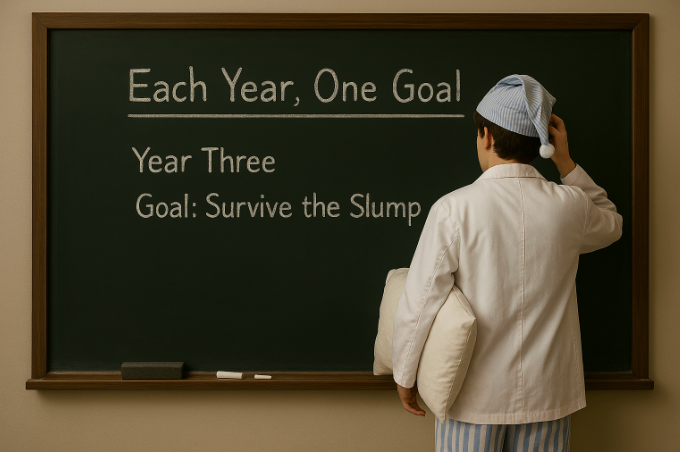
The PhD is a long journey full of ups and downs. This sounds cliché (big warning, this blog will be full of them) but in my opinion, the PhD is the ultimate example of the expression “it’s not a sprint, it's a marathon”. As a fifth year and, hopefully, finishing my grad school journey during this school year, I tend to talk with a lot of younger students who are just starting or are in the middle of their PhD about their experiences. I often share with them some of the expectations I had or the good and bad things I’ve faced as I look back at my journey. I had one big realization I want to share with you guys through this blog. I concluded that “PhD can be summarized in the fact that every school year has one clear goal.. This is a very simple and very loose way to describe it and yes, I’m skipping a lot of the small details that happen throughout the process, but if we step back and look at the big picture, I think you’ll get what I mean. For the rest of this blog, I’ll go through each of the five years (or so) that it takes to complete a PhD and explain what I think is the objective of every year. My goal is to help students that are currently anxious about the future years, those who are a bit lost and lack the motivation of what to do next and/or students who are looking for a broad idea of what the PhD journey is, and try to answer some of the questions they might have or help them focus on what they could be focusing right now and even planning for the future. With that long winded intro, let’s continue with the series and talk about year three.
Big clarification, I’m a Chemistry PhD student so my journey and the way each year works is based on that premise and can be easily applied in most of the STEM PhDs. For other areas, the process might be quite different, but I hope this at least can give some idea of how this works for those in other areas.\
Year Three
Goal: Survive the slump
If Year Two was about your Qualifying Exam and officially becoming a PhD candidate, Year Three is about something a lot less glamorous but just as important: surviving the slump. This is the year that truly tests your endurance more than your intelligence. It’s that stretch of the marathon where you’ve already passed the cheering crowds and the starting adrenaline is long gone, but the finish line still feels like a distant dream. You’re no longer the new student figuring things out, but you’re not close to being done either. You’re right in the middle, and that’s exactly why Year Three feels tough.
The summer after your QE feels amazing at first. You finally passed that huge milestone, you’re a PhD candidate, and for the first time, you can focus entirely on research without classes or looming exams. The lab becomes your world, and it feels great to just do science. But give it a few weeks, and reality sets in. Without the structure that classes and exams once gave you, it’s suddenly up to you to decide what “progress” means. There’s no clear finish line in sight—just long experiments, slow results, and an ever-growing to-do list. That freedom can feel overwhelming. This is when creating your own structure becomes essential. Set small, achievable goals: finish analyzing a dataset, write a short draft for a future paper, or prepare an abstract for a conference. Keep yourself moving, even with small steps, so the motivation doesn’t fade before the semester begins.
Once the fall semester hits, many students start feeling what I call the real “slump.” The work becomes routine, the results unpredictable, and the days begin to blend together. It’s easy to question whether you’re actually making progress or if you even belong here. Spoiler: you do. Everyone goes through this phase, even if most people don’t talk about it. Experiments fail for reasons you can’t explain, instruments break, and suddenly you’ve spent two weeks trying to fix something that used to work perfectly fine. It’s frustrating and exhausting. But it’s also normal. Research isn’t a straight line, it’s a messy loop of trial, error, and occasional small victories.
Year Three is when you learn to redefine progress. Instead of expecting breakthroughs every month, start celebrating the small wins, getting a method to finally work, mentoring a new student, organizing your data, or finally figuring out why your reaction wasn’t reproducible. These things might feel minor, but they’re the backbone of scientific growth. It’s also a great time to reconnect with your “why.” Go back to those papers or topics that first made you excited about your field. Attend seminars outside your immediate area just because they sound interesting. Talk to people from other groups, not to collaborate necessarily, but to hear how their challenges and routines compare to yours. Sometimes, hearing someone else’s research frustrations reminds you that you’re not alone in this.
And speaking of not being alone, year three is when it becomes essential to build a support system outside of your lab. This is a great time to get involved in student organizations, affinity groups, or leadership roles. Join the Chemistry Graduate Student Association, the Latin American Graduate Student Association, or any group that helps you connect with others. It breaks the monotony of lab work and gives you a sense of community. You can also take advantage of opportunities to develop new skills through programs like the Doerr Institute for New Leaders or the Center for Teaching Excellence’s certificate programs. These experiences not only help you grow as a person but also remind you that your PhD is more than just research, it’s about developing as a professional and as a leader.
If you ever find yourself struggling mentally or emotionally, and believe me, most people do at some point, remember that Rice has excellent resources like the Rice Wellbeing and Counseling Center. They exist precisely because this phase can be difficult. There’s no shame in reaching out for help or even just talking to someone about how you feel. Sometimes, the best support comes from your own cohort, since they’re likely going through the same ups and downs. You don’t have to face the slump alone, it’s always easier when you go through it together.
By the time spring semester arrives, things slowly start falling into place again. You begin to see patterns in your data, you’ve learned to troubleshoot problems faster, and your results start making a bit more sense. This is also when you can begin drafting sections of your dissertation or preparing your first paper. Even if it feels early, start writing, methods, results summaries, anything. Writing helps you organize your thoughts and realize how much you’ve already accomplished, even if it doesn’t feel like it yet. You’ll thank yourself later for having those notes ready.
Looking back, Year Three might not be the most exciting part of the PhD, but it’s one of the most transformative. You’ll come out of it more independent, resilient, and confident in your ability to handle uncertainty. It’s the year you quietly build the habits, mindset, and perseverance that will carry you through to the finish line. It’s not the year of big results, it’s the year of steady growth.
And the best part? The slump doesn’t last forever. As you move into Year Four, the rhythm changes again. The work starts paying off, new opportunities appear, and that sense of purpose comes back stronger than before. Year Three teaches you how to keep going when things feel slow, and that’s the skill that makes everything else possible.
So, if you’re currently in the slump year, hang in there. You’re not stuck, you’re building the foundation for everything that comes next. The light at the end of the tunnel is real, and you’re already walking toward it, one experiment at a time.
In the next chapter of this series, I’ll cover the summer after year two and the journey through year four. Stay tuned, and I hope this was useful for you.
About the author:
Manuel Carmona Pichardo is from Pachuca Hidalgo, Mexico and is a current Ph.D. student in Chemistry. He got his B.S. in Chemistry at Universidad Autónoma del Estado de Hidalgo in 2016 and his MSc in Chemistry from Cologne University in Cologne Germany. Read More
Further Reading:
PhD Retrospective: Each semester, One objective. Year One
PhD retrospective each semester one objective. Year Two.
PhD retrospective each semester one objective. Year Four.
Advice from a 6th Year PhD student