
The Ph.D. is long journey full of ups and downs. Sounds cliché (big warning, this blog will be full of them) but in my opinion, is the ultimate example of the expression “it’s not a sprint, is a marathon”. As a fifth year and, hopefully, finishing my grad school journey during this school year, I tend to talk with a lot of younger students who are just starting or are at the middle of their PhD about the entire experience and some of the expectations I had or the good and bad things I’ve faced and as I look back at all this process I had one big realization I want to share with you guys through this blog. I concluded that “PhD can be summarized in the fact that every school year has one clear goal”. It’s a very simple and very loose way to describe it and yes, I’m skipping a lot of the small details that happen throughout the process, but if we step back and look at the big picture, I think you’ll get what I mean. For the rest of this blog, I’ll go through each of the five years (or so) that takes to complete a PhD and explain what I think is the objective of every year. My goal is to help those students that are currently anxious about the future years, those who are a bit lost and lack the motivation of what to do next and/or students who are looking for a broad idea of what the PhD journey is, and try to answer some of the questions they might have or help them focus on what they could be focusing right now and even planning for the future. With that long winded intro, let’s continue with the series and talk about the last year, year five.
Big clarification, I’m a Chemistry PhD student so my journey and the way each year works is based on that premise and can be easily applied in most of the STEM PhDs. For other areas the process might be quite different, but I hope this at least can give some idea of how this works for those in other areas.
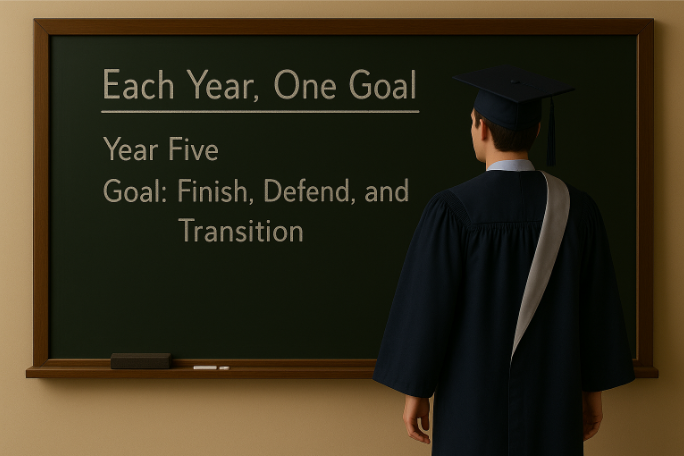
Year five
Goal: Finish, Defend, and Transition
Welcome to Year Five, the “So… this is it?” year. If Year Three was the slump and Year Four was the slow, steady climb back to clarity, Year Five is when you finally see land. Not close enough to stand on it, but close enough that you start rehearsing your “I actually made it” smile. And the funny thing is: I’m writing this one right now, as someone at the end of the first semester of Year Five, deep in the process of wrapping up projects, outlining my dissertation, juggling experiments that occasionally decide to cooperate, and aiming, with a mix of optimism, caffeine, and gentle existential dread, for a summer graduation.
One of the most surreal parts of Year Five is watching people around you start reaching the finish line. Some senior students you looked up to have already graduated, people who, at some point, felt like permanent fixtures of the lab, like they were never going to leave (until suddenly they did). And now, members of your own cohort are defending, accepting job offers, moving out, and posting celebratory photos in regalia. It hits with a strange emotional mix: you’re proud of them, genuinely excited to see them succeed, but there’s also the quiet ache of knowing things won’t be the same without them. It’s the bittersweet sensation of cheering someone on while realizing your circle is changing shape. You don’t want them to leave, but you do want them to shine. And somewhere in the middle of that emotional cocktail, you realize… your turn is coming too.
Being in the first semester of Year Five feels like living in a transition zone. You’re still running experiments, but every experiment suddenly has a purpose, and that purpose is simple: “Will this go into the dissertation?” You start prioritizing like a seasoned strategist. Nice-to-have ideas turn into “future directions.” Overly ambitious side quests become “not in this lifetime.” Perfectionism fades, not out of defeat, but out of wisdom. At this stage, “good enough for publication” is not a moral failure, it’s project management. And of course, this year is when the dissertation stops being a mythological creature and becomes a living, breathing, slightly messy Word document. Chapters begin to form. Figures start taking shape. Methods you regret not documenting better come back to haunt you. You discover random spectra screenshots and ask, “Past me, what were you doing?” But between the chaos, something beautiful happens: you see, with your own eyes, how much you’ve actually done. The volume of work becomes a real motivator.
Year Five is also a year of closure. You start training the next generation of students. You pass down protocols, hard-earned tricks, and the “what I wish I knew” list. You begin cleaning notebooks, organizing data, tying up loose ends. It’s a shift from building chaos to building legacy, leaving things better than you found them. And through all of this, your support systems become more precious than ever, friends inside and outside the lab, mentors, family, and, especially, your cohort, the people who truly understand the emotional roller coaster because they’re on the same ride. The group chats, the coffee runs, the shared complaints, the “you got this” messages right before committee meetings… Year Five makes you deeply grateful for the people who have walked this path with you.
Emotionally, the year can get heavy. Watching others finish, feeling the pressure of your own timeline, managing the final push, it’s a lot. But there’s also something grounding about it. You’ve learned to navigate setbacks, organize your time, communicate better, ask for help, recover more quickly, and think more clearly. By Year Five, you’re not just producing research, you’ve become a scientist.
For me, the next six months are a final push: the last data sets, the last manuscript polishing, the final experiments, the preparation for the defense, and the creation of a dissertation that reflects both the science and the journey. I’m aiming for a summer graduation, and while it’s intense, it’s also incredibly motivating. Seeing the finish line changes everything. It brings clarity, purpose, and a type of determination you only discover once you’re this close. And here’s the thing I didn’t expect: Year Five brings a sense of peace. Not because it’s easy, it’s not, but because the direction is finally clear. The story is coming together. The steps ahead make sense. And the person you’ve become, after all these years, is stronger, more confident, more intentional, and more capable than the one who began this journey.
So here’s to Year Five: the year of closing chapters, cheering for friends who graduate before you, preparing your own finish line, and realizing that you’ve grown in ways you couldn’t have imagined when you started. It’s a year of hard work, but also a year of meaning, and as I make my way through this final stretch, I can truly say: the end is in sight, and it feels good.
About the author:
Manuel Carmona Pichardo is from Pachuca Hidalgo, Mexico and is a current Ph.D. student in Chemistry. He got his B.S. in Chemistry at Universidad Autónoma del Estado de Hidalgo in 2016 and his MSc in Chemistry from Cologne University in Cologne Germany. Read More
Further Reading:
PhD Retrospective: Each semester, One objective. Year One
PhD retrospective each semester one objective. Year Two.